Q23 / 60 · JEE Advanced 2009 (Paper 1) · Mathematics
Let $P(3,2,6)$ be a point in space and $Q$ be a point on the line $\mathbf{r}=(\hat{\mathbf{i}}-\hat{\mathbf{j}}+2 \hat{\mathbf{k}})+\mu(-3 \hat{\mathbf{i}}+\hat{\mathbf{j}}+5 \hat{\mathbf{k}})$.
Then, the value of $\mu$ for which the vector $\mathbf{P Q}$ is parallel to the plane $x-4 y+3 z=1$ is
- Correct answerA$1 / 4$
- B$-1 / 4$
- C$1 / 8$
- D$-1 / 8$
Solution
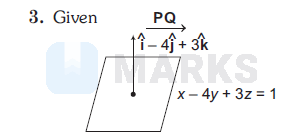
$\mathbf{O Q}=(1-3 \mu) \mathbf{i}+(\mu-1) \mathbf{j}+(5 \mu+2) \mathbf{k}$ and $\mathbf{O P}=3 \hat{\mathbf{i}}+2 \hat{\mathbf{j}}+6 \hat{\mathbf{k}}$, where $O$ is origin. $$ \begin{aligned} & \text { Now, } \mathbf{P Q}=(1-3 \mu-3) \hat{\mathbf{i}}+(\mu-1-2) \hat{\mathbf{j}} \\ & +(5 \mu+2-6) \hat{\mathbf{k}} \\ & =(2-3 \mu) \hat{\mathbf{i}}+(\mu-3) \hat{\mathbf{j}}+(5 \mu-4) \hat{\mathbf{k}} \\ & \end{aligned} $$ $\because \mathbf{P Q}$ is parallel to the plane $$ \begin{array}{rr} & x-4 y+3 z=1 . \\ \therefore & -2-3 \mu-4 \mu+12+15 \mu-12=0 \\ \Rightarrow & 8 \mu=2 \Rightarrow \mu=\frac{1}{4} \end{array} $$
Hence, the correct answer is option: 'A'.