Q217 / 270 · NDA 2017 (Phase 1) · Mathematics
Let $A B C D$ be a parallelogram whose diagonals intersect at P and let O be the origin. What is $\overrightarrow{\mathrm{OA}}+\overrightarrow{\mathrm{OB}}+\overrightarrow{\mathrm{OC}}+\overrightarrow{\mathrm{OD}}$ equal to?
- A$2 \overrightarrow{\mathrm{OP}}$
- Correct answerB$4 \overrightarrow{\mathrm{OP}}$
- C$6 \overrightarrow{\mathrm{OP}}$
- D$8 \overrightarrow{\mathrm{OP}}$
Solution
From the figure, observe that
$\overrightarrow{\mathrm{OA}}+\overrightarrow{\mathrm{AP}}=\overrightarrow{\mathrm{OP}}$
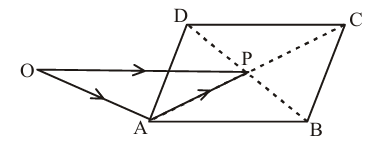
Similarly, $\overrightarrow{\mathrm{OB}}+\overrightarrow{\mathrm{BP}}=\overrightarrow{\mathrm{OP}}$ $\begin{gathered} \overrightarrow{\mathrm{OC}}+\overrightarrow{\mathrm{CP}}=\overrightarrow{\mathrm{OP}} \\ \overrightarrow{\mathrm{OD}}+\overrightarrow{\mathrm{DP}}=\overrightarrow{\mathrm{OP}} \\ \Rightarrow \overrightarrow{\mathrm{OA}}+\overrightarrow{\mathrm{OB}}+\overrightarrow{\mathrm{OC}}+\overrightarrow{\mathrm{OD}}+\overrightarrow{\mathrm{AP}} \\ +\overrightarrow{\mathrm{BP}}+\overrightarrow{\mathrm{CP}}+\overrightarrow{\mathrm{DP}}=4 \overrightarrow{\mathrm{OP}} \end{gathered}$ In a parallelogram, diagonals bisect each other. $\begin{aligned} & \therefore|\overrightarrow{\mathrm{AP}}|=|\overrightarrow{\mathrm{PC}}| \\ & \Rightarrow \overrightarrow{\mathrm{AP}}=-\overrightarrow{\mathrm{PC}} \\ & \Rightarrow \overrightarrow{\mathrm{AP}}+\overrightarrow{\mathrm{PC}}=0 \end{aligned}$ $(\text { Since } \mathrm{AP}=\mathrm{CP})$ Similarly $\overrightarrow{\mathrm{BP}}+\overrightarrow{\mathrm{DP}}=\mathrm{O}$ $\therefore \text { (i) } \Rightarrow \overrightarrow{\mathrm{OA}}+\overrightarrow{\mathrm{OB}}+\overrightarrow{\mathrm{OC}}+\overrightarrow{\mathrm{OD}}=4 \overrightarrow{\mathrm{OP}}$
Similarly, $\overrightarrow{\mathrm{OB}}+\overrightarrow{\mathrm{BP}}=\overrightarrow{\mathrm{OP}}$ $\begin{gathered} \overrightarrow{\mathrm{OC}}+\overrightarrow{\mathrm{CP}}=\overrightarrow{\mathrm{OP}} \\ \overrightarrow{\mathrm{OD}}+\overrightarrow{\mathrm{DP}}=\overrightarrow{\mathrm{OP}} \\ \Rightarrow \overrightarrow{\mathrm{OA}}+\overrightarrow{\mathrm{OB}}+\overrightarrow{\mathrm{OC}}+\overrightarrow{\mathrm{OD}}+\overrightarrow{\mathrm{AP}} \\ +\overrightarrow{\mathrm{BP}}+\overrightarrow{\mathrm{CP}}+\overrightarrow{\mathrm{DP}}=4 \overrightarrow{\mathrm{OP}} \end{gathered}$ In a parallelogram, diagonals bisect each other. $\begin{aligned} & \therefore|\overrightarrow{\mathrm{AP}}|=|\overrightarrow{\mathrm{PC}}| \\ & \Rightarrow \overrightarrow{\mathrm{AP}}=-\overrightarrow{\mathrm{PC}} \\ & \Rightarrow \overrightarrow{\mathrm{AP}}+\overrightarrow{\mathrm{PC}}=0 \end{aligned}$ $(\text { Since } \mathrm{AP}=\mathrm{CP})$ Similarly $\overrightarrow{\mathrm{BP}}+\overrightarrow{\mathrm{DP}}=\mathrm{O}$ $\therefore \text { (i) } \Rightarrow \overrightarrow{\mathrm{OA}}+\overrightarrow{\mathrm{OB}}+\overrightarrow{\mathrm{OC}}+\overrightarrow{\mathrm{OD}}=4 \overrightarrow{\mathrm{OP}}$
Hence, the correct answer is option: 'B'.