Q34 / 69 · JEE Advanced 2011 (Paper 1) · Mathematics
Let $f: R \rightarrow R$ be a function such that $f(x+y)=f(x)+f(y), \forall x, y \in R$. If $f(x)$ is differentiable at $x=0$, then
- A$f(x)$ is differentiable only in a finite interval containing zero
- Correct answerB$f(x)$ is continuous, $\forall x \in R$
- Correct answerC$f^{\prime}(x)$ is constant, $\forall x \in R$
- D$f(x)$ is differentiable except at finitely many points
Solution
$f(x+y)=f(x)+f(y)$, as $f(x)$ is differentiable at $x=0$.
$$
\begin{aligned}
\Rightarrow & f^{\prime}(0)=k \\
\text { Now, } f^{\prime}(x) & =\lim _{h \rightarrow 0} \frac{f(x+h)-f(x)}{h} \\
& =\lim _{h \rightarrow 0} \frac{f(x)+f(h)-f(x)}{h} \\
& =\lim _{h \rightarrow 0} \frac{f(h)}{h} \quad\left[\frac{0}{0} \text { from }\right]
\end{aligned}
$$
Given, $f(x+y)=f(x)+f(y), \forall x, y$
$$
\begin{aligned}
& \therefore & f(0) & =f(0)+f(0), \\
& \text { when } & x & =y=0 \Rightarrow f(0)=0
\end{aligned}
$$
Using L'Hospital's rule,
$$
\lim _{h \rightarrow 0} \frac{f^{\prime}(h)}{1}=f^{\prime}(0)=k
$$
$\Rightarrow f^{\prime}(x)=k$, on integrating both sides, $f(x)=k x+C$, as $f(0)=0 \Rightarrow C=0$
So, $f(x)=k x$
$\therefore f(x)$ is continuous for all $x \in R$ and $f^{\prime}(x)=k$, i.e. constant for all $x \in R$.
Hence, both (b) and (c) are correct.
Solutions (Q. Nos. 12-13)
$$
\left.\left(\begin{array}{l}
3 \mathrm{~W} \\
2 \mathrm{R}
\end{array}\right)(\underbrace{1 \mathrm{~W}}_{u_1})\right\} \text { Initial }
$$
Head appears.
$\left(\begin{array}{l}2 \mathrm{~W} \\ 2 \mathrm{R}\end{array}\right) \underset{u_1}{\mathrm{wW}}(\underbrace{2 \mathrm{~W}}_{u_2})$
or $\left.\left(\begin{array}{l}3 \mathrm{~W} \\ 1 \mathrm{R}\end{array}\right) \underset{u_1}{\stackrel{1 \mathrm{R}}{u_1}}\left(\begin{array}{c}1 \mathrm{~W} \\ 1 \mathrm{R}\end{array}\right)\right)_{u_2}^{u_2}$
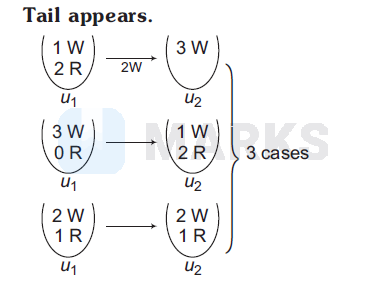
Hence, the correct answer is options: 'B', 'C'.