Q56 / 150 · JEE Main 2006 · Mathematics
$A B C$ is a triangle, right angled at $A$. The resultant of the forces acting along $\overrightarrow{A B}, \overrightarrow{A C}$ with magnitudes $\frac{1}{A B}$ and $\frac{1}{A C}$ respectively is the force along $\overrightarrow{A D}$, where $D$ is the foot of the perpendicular from $\mathrm{A}$ onto $\mathrm{BC}$. The magnitude of the resultant is
- A$\frac{A B^2+A C^2}{(A B)^2(A C)^2}$
- B$\frac{(A B)(A C)}{A B+A C}$
- C$\frac{1}{A B}+\frac{1}{A C}$
- Correct answerD$\frac{1}{\mathrm{AD}}$
Solution
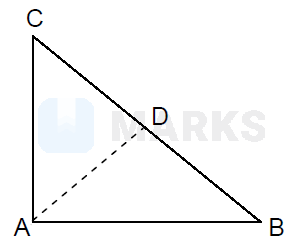
Magnitude of resultant $$ \begin{aligned} & =\sqrt{\left(\frac{1}{A B}\right)^2+\left(\frac{1}{A C}\right)^2}=\frac{\sqrt{A B^2+A C^2}}{A B \cdot A C} \\ & =\frac{B C}{A B \cdot A C}=\frac{B C}{A D \cdot B C}=\frac{1}{A D} \end{aligned} $$
Hence, the correct answer is option: 'D'.