Q10 / 155 · WBJEE 2026 · Chemistry
In the following reaction sequence, the product $Y$ is
$Br(CH_2)_{12} - C \equiv CH \xrightarrow{\text{NaNH}_2} X \xrightarrow[\text{catalyst}]{\text{H}_2,\text{Lindler}} Y$
$Br(CH_2)_{12} - C \equiv CH \xrightarrow{\text{NaNH}_2} X \xrightarrow[\text{catalyst}]{\text{H}_2,\text{Lindler}} Y$
- A
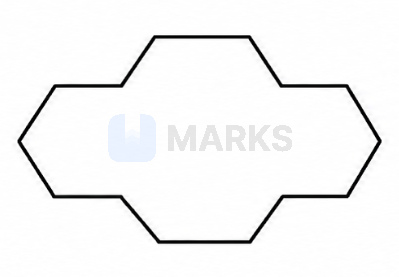
- Correct answerB
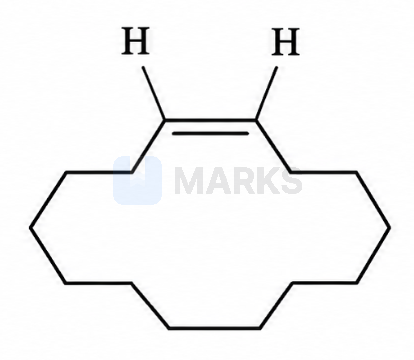
- C$Br(CH_2)_{12} - CH = CH_2$
- D
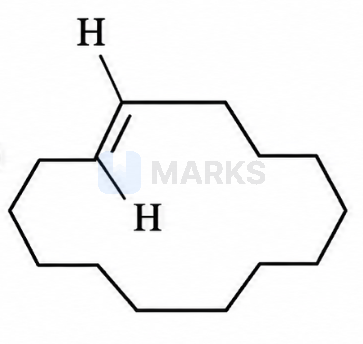
Solution
The given reactant is $Br(CH_2)_{12} - C \equiv CH$.
When treated with $NaNH_2$ (a strong base), the acidic terminal alkyne proton is abstracted to form an acetylide ion:
$Br(CH_2)_{12} - C \equiv CH \xrightarrow{NaNH_2} Br(CH_2)_{12} - C \equiv C^- Na^+$
This acetylide ion undergoes an intramolecular $S_N2$ reaction. The nucleophilic carbon attacks the carbon bearing the bromine atom, displacing the bromide ion. This results in the formation of a 14-membered cyclic alkyne, cyclotetradecyne (Product X).
Next, cyclotetradecyne is treated with $H_2$ in the presence of Lindlar's catalyst. Lindlar's catalyst ($Pd/CaCO_3$ poisoned with lead acetate or quinoline) is used for the partial reduction of alkynes to alkenes. It specifically undergoes syn-addition of hydrogen, converting the alkyne into a cis-alkene.
Therefore, the triple bond in cyclotetradecyne is reduced to a cis double bond, yielding cis-cyclotetradecene as Product Y.
Option (B) correctly represents the structure of cis-cyclotetradecene.
Answer:
Hence, the correct answer is option: 'B'.