Q14 / 54 · JEE Advanced 2026 (Paper 2) · Chemistry
In the following reaction sequence, major products $\textbf{X}$ and $\textbf{Y}$ are acyclic monomers.
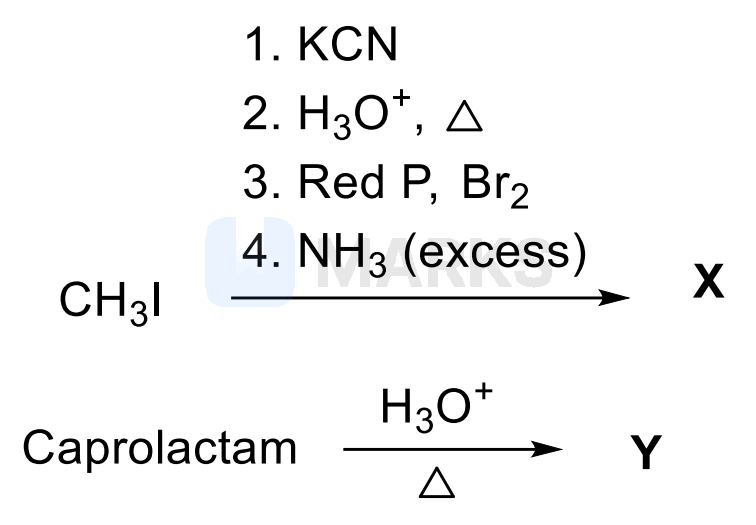
$500$ mol of $\textbf{X}$ completely reacts with $500$ mol of $\textbf{Y}$ to give $1$ mol of a single biodegradable acyclic copolymer $\textbf{Z}$ as the only product. The amount of $\textbf{Z}$ formed in grams is ____.
Given:
Atomic mass (in amu): H : $1$, C : $12$, N : $14$, O : $16$, Br : $80$
$500$ mol of $\textbf{X}$ completely reacts with $500$ mol of $\textbf{Y}$ to give $1$ mol of a single biodegradable acyclic copolymer $\textbf{Z}$ as the only product. The amount of $\textbf{Z}$ formed in grams is ____.
Given:
Atomic mass (in amu): H : $1$, C : $12$, N : $14$, O : $16$, Br : $80$
Correct answer: 85018
Solution
Step 1: Identification of monomer $\textbf{X}$
The given reaction sequence for $\textbf{X}$ is:
$\text{CH}_3\text{I} \xrightarrow{\text{KCN}} \text{CH}_3\text{CN}$
$\text{CH}_3\text{CN} \xrightarrow{\text{H}_3\text{O}^+, \Delta} \text{CH}_3\text{COOH}$
$\text{CH}_3\text{COOH} \xrightarrow{\text{Red P, Br}_2} \text{BrCH}_2\text{COOH}$ (Hell-Volhard-Zelinsky reaction)
$\text{BrCH}_2\text{COOH} \xrightarrow{\text{NH}_3 \text{ (excess)}} \text{H}_2\text{N}-\text{CH}_2-\text{COOH}$
Thus, $\textbf{X}$ is Glycine.
Molar mass of $\textbf{X}$ ($\text{C}_2\text{H}_5\text{NO}_2$) = $2(12) + 5(1) + 14 + 2(16) = 75 \text{ g/mol}$.
Step 2: Identification of monomer $\textbf{Y}$
Caprolactam on acidic hydrolysis gives $\epsilon$-aminocaproic acid:
Caprolactam $\xrightarrow{\text{H}_3\text{O}^+, \Delta} \text{H}_2\text{N}-(\text{CH}_2)_5-\text{COOH}$
Thus, $\textbf{Y}$ is $\epsilon$-aminocaproic acid.
Molar mass of $\textbf{Y}$ ($\text{C}_6\text{H}_{13}\text{NO}_2$) = $6(12) + 13(1) + 14 + 2(16) = 131 \text{ g/mol}$.
Step 3: Calculation of the mass of copolymer $\textbf{Z}$
The copolymer $\textbf{Z}$ is Nylon-2-nylon-6, which is a biodegradable polyamide formed by the condensation polymerization of Glycine and $\epsilon$-aminocaproic acid.
The problem states that $500 \text{ mol}$ of $\textbf{X}$ and $500 \text{ mol}$ of $\textbf{Y}$ completely react to form $1 \text{ mol}$ of a single acyclic copolymer $\textbf{Z}$.
This means each molecule of polymer $\textbf{Z}$ contains $500$ units of $\textbf{X}$ and $500$ units of $\textbf{Y}$, making a total of $1000$ monomer units.
In an acyclic chain of $1000$ monomers, the number of peptide (amide) bonds formed is $1000 - 1 = 999$.
For each peptide bond formed, one molecule of water ($\text{H}_2\text{O}$) is eliminated. Since $1 \text{ mol}$ of polymer $\textbf{Z}$ is formed, $999 \text{ mol}$ of water are eliminated.
Applying the law of conservation of mass:
Mass of $\textbf{Z}$ = (Mass of $500 \text{ mol}$ of $\textbf{X}$) + (Mass of $500 \text{ mol}$ of $\textbf{Y}$) - (Mass of $999 \text{ mol}$ of $\text{H}_2\text{O}$)
Mass of $\textbf{Z} = (500 \times 75) + (500 \times 131) - (999 \times 18)$
Mass of $\textbf{Z} = 37500 + 65500 - 17982$
Mass of $\textbf{Z} = 103000 - 17982 = 85018 \text{ g}$
Answer: $85018$
Hence, the correct answer is 85018.