Q8 / 54 · JEE Advanced 2026 (Paper 2) · Chemistry
In the following reaction sequence, $\textbf{P}$, $\textbf{Q}$, $\textbf{S}$ and $\textbf{T}$ are the major products.
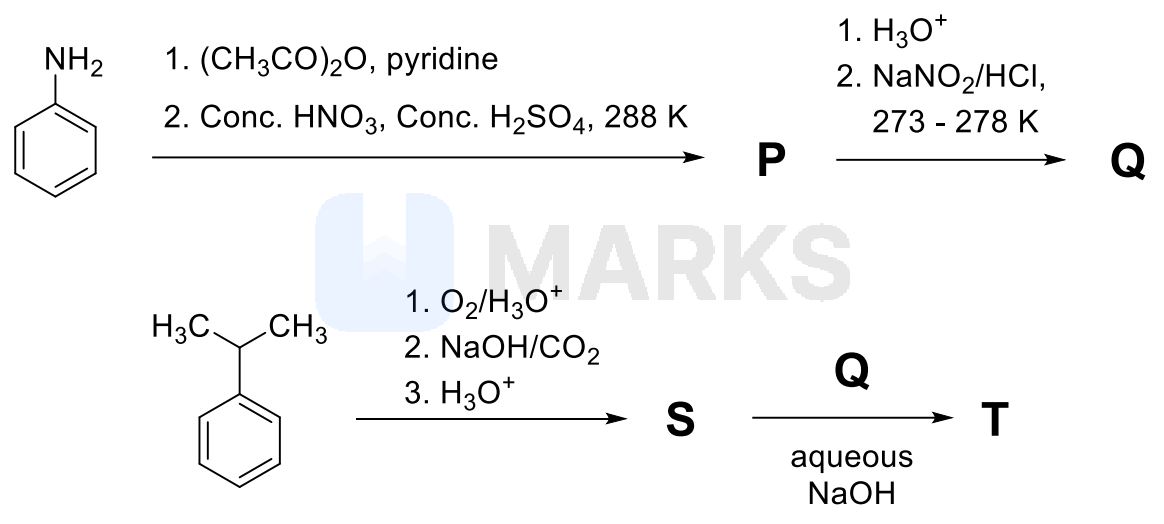
The correct statement(s) about $\textbf{P}$, $\textbf{Q}$, $\textbf{S}$ and $\textbf{T}$ is(are)
The correct statement(s) about $\textbf{P}$, $\textbf{Q}$, $\textbf{S}$ and $\textbf{T}$ is(are)
- A$\textbf{Q}$ on treatment with ethanol generates an aromatic aldehyde.
- Correct answerB$\textbf{S}$ gives positive phthalein dye test.
- C$\textbf{P}$ is a dinitro compound.
- Correct answerD$\textbf{T}$ is a coloured compound.
Solution
In the first reaction sequence:
Step 1: Aniline reacts with acetic anhydride in the presence of pyridine to undergo acetylation, forming acetanilide.
Step 2: Acetanilide is treated with a nitrating mixture (conc. $\text{HNO}_3$ and conc. $\text{H}_2\text{SO}_4$) at $288 \text{ K}$. The $-\text{NHCOCH}_3$ group is moderately activating and ortho/para directing. Due to steric hindrance, the major product $\textbf{P}$ is $p$-nitroacetanilide.
Step 3: $\textbf{P}$ is hydrolyzed with $\text{H}_3\text{O}^+$ to yield $p$-nitroaniline.
Step 4: $p$-nitroaniline is diazotized using $\text{NaNO}_2/\text{HCl}$ at $273-278 \text{ K}$ to form the diazonium salt $\textbf{Q}$, which is $p$-nitrobenzenediazonium chloride.
In the second reaction sequence:
Step 1: Cumene (isopropylbenzene) is oxidized by $\text{O}_2$ followed by acid hydrolysis ($\text{H}_3\text{O}^+$) to produce phenol and acetone. The major aromatic product is phenol.
Step 2: Phenol undergoes the Kolbe-Schmitt reaction with $\text{NaOH}$ and $\text{CO}_2$ to form sodium salicylate.
Step 3: Acidification with $\text{H}_3\text{O}^+$ yields salicylic acid as the major product $\textbf{S}$.
In the final reaction:
Salicylic acid ($\textbf{S}$) reacts with $p$-nitrobenzenediazonium chloride ($\textbf{Q}$) in an aqueous $\text{NaOH}$ medium. This is an electrophilic aromatic substitution (azo coupling). The phenoxide ion formed is highly activating, and coupling occurs at the para position with respect to the $-\text{OH}$ group (position 5 of salicylic acid). The resulting product $\textbf{T}$ is an azo dye, which is a highly conjugated and coloured compound.
Evaluating the options:
(A) Treatment of $\textbf{Q}$ ($p$-nitrobenzenediazonium chloride) with ethanol reduces the diazonium group, yielding nitrobenzene, not an aromatic aldehyde. (Incorrect)
(B) The phthalein dye test is a characteristic test for phenols. Salicylic acid ($\textbf{S}$) contains a phenolic $-\text{OH}$ group with a free para position (position 5) and gives a positive phthalein dye test when heated with phthalic anhydride and conc. $\text{H}_2\text{SO}_4$. (Correct)
(C) $\textbf{P}$ is $p$-nitroacetanilide, which is a mononitro compound, not a dinitro compound. (Incorrect)
(D) $\textbf{T}$ is an azo dye, which is a coloured compound. (Correct)
Answer: $\textbf{S}$ gives positive phthalein dye test.; $\textbf{T}$ is a coloured compound.
Hence, the correct answer is options: 'B', 'D'.