Q133 / 180 · COMEDK 2023 (Memory Based) · Physics
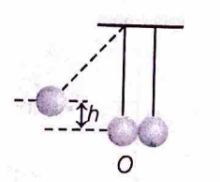
In the figure, pendulum bob on left side is pulled a side to a height $h$ from its initial position. After it is released it collides with the right pendulum bob at rest, which is of same mass. After the collision, the two bobs stick ogether and rise to a height
- A$\frac{3 h}{4}$
- B$\frac{2 h}{3}$
- C$\frac{h}{2}$
- Correct answerD$\frac{h}{4}$
Solution
When bob $A$ strikes to the bob $B$, then
$m u=(m+m) v^{\prime}$

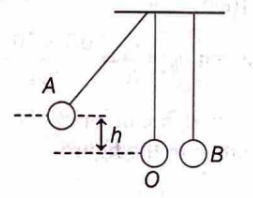
The potential energy of $A$ at height $h$ gets converted into kinetic energy of this mass, at point $O$, i.e. $\begin{array}{rlrl} & m g h =\frac{1}{2} m u^2 \\ \Rightarrow \quad u & =\sqrt{2 g h} & [From Eq. (i)] \\ \therefore \quad v^{\prime} & =\frac{\sqrt{2 g h}}{2}=\sqrt{\frac{g h}{2}} \end{array}$ Let the combined mass moves to a height $h^{\prime}$, then total mass $=2 m$ Then, $2 m g h^{\prime}=\frac{1}{2}(2 m) v^{\prime 2}$ $\Rightarrow \quad g h^{\prime}=\frac{g h}{4} \Rightarrow h^{\prime}=\frac{h}{4}$
The potential energy of $A$ at height $h$ gets converted into kinetic energy of this mass, at point $O$, i.e. $\begin{array}{rlrl} & m g h =\frac{1}{2} m u^2 \\ \Rightarrow \quad u & =\sqrt{2 g h} & [From Eq. (i)] \\ \therefore \quad v^{\prime} & =\frac{\sqrt{2 g h}}{2}=\sqrt{\frac{g h}{2}} \end{array}$ Let the combined mass moves to a height $h^{\prime}$, then total mass $=2 m$ Then, $2 m g h^{\prime}=\frac{1}{2}(2 m) v^{\prime 2}$ $\Rightarrow \quad g h^{\prime}=\frac{g h}{4} \Rightarrow h^{\prime}=\frac{h}{4}$
Hence, the correct answer is option: 'D'.