Q142 / 200 · Manipal (MET) 2010 · Physics
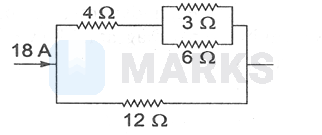
In the electrical network shown in the figure, the potential difference across $3 \Omega$ resistance will be
- A12 V
- B2.4 V
- Correct answerC24 V
- D36 V
Solution
As $3 \Omega$ and $6 \Omega$ resistances are in parallel their equivalent resistance will be $2 \Omega$. Here $2 \Omega$ and $4 \Omega$ are in series, their equivalent resistance will be $6 \Omega$.
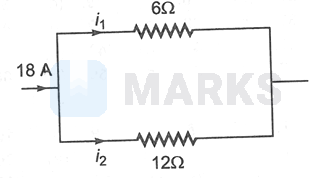
From current distribution law $\begin{aligned} & i_1=\frac{12 \times 18}{18}=12 \mathrm{~A} \\ & i_2=\frac{6 \times 18}{18}=6 \mathrm{~A} \end{aligned}$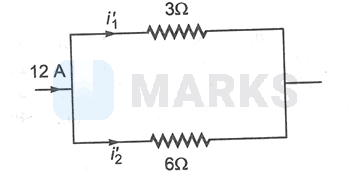
Now 12 A current is entering in parallel combination of $3 \Omega$ and $6 \Omega$ again from current distribution law $i_1^{\prime}=\frac{6 \times 12}{9}=8 \mathrm{~A}$ $i_2^{\prime}=\frac{3 \times 12}{9}=4 \mathrm{~A}$ $\therefore$ Potential difference across $3 \Omega$ resistance $=8 \times 3=24 \mathrm{~V}$
From current distribution law $\begin{aligned} & i_1=\frac{12 \times 18}{18}=12 \mathrm{~A} \\ & i_2=\frac{6 \times 18}{18}=6 \mathrm{~A} \end{aligned}$
Now 12 A current is entering in parallel combination of $3 \Omega$ and $6 \Omega$ again from current distribution law $i_1^{\prime}=\frac{6 \times 12}{9}=8 \mathrm{~A}$ $i_2^{\prime}=\frac{3 \times 12}{9}=4 \mathrm{~A}$ $\therefore$ Potential difference across $3 \Omega$ resistance $=8 \times 3=24 \mathrm{~V}$
Hence, the correct answer is option: 'C'.