Q123 / 150 · MHT CET 2026 (15 April Shift 2) · Physics
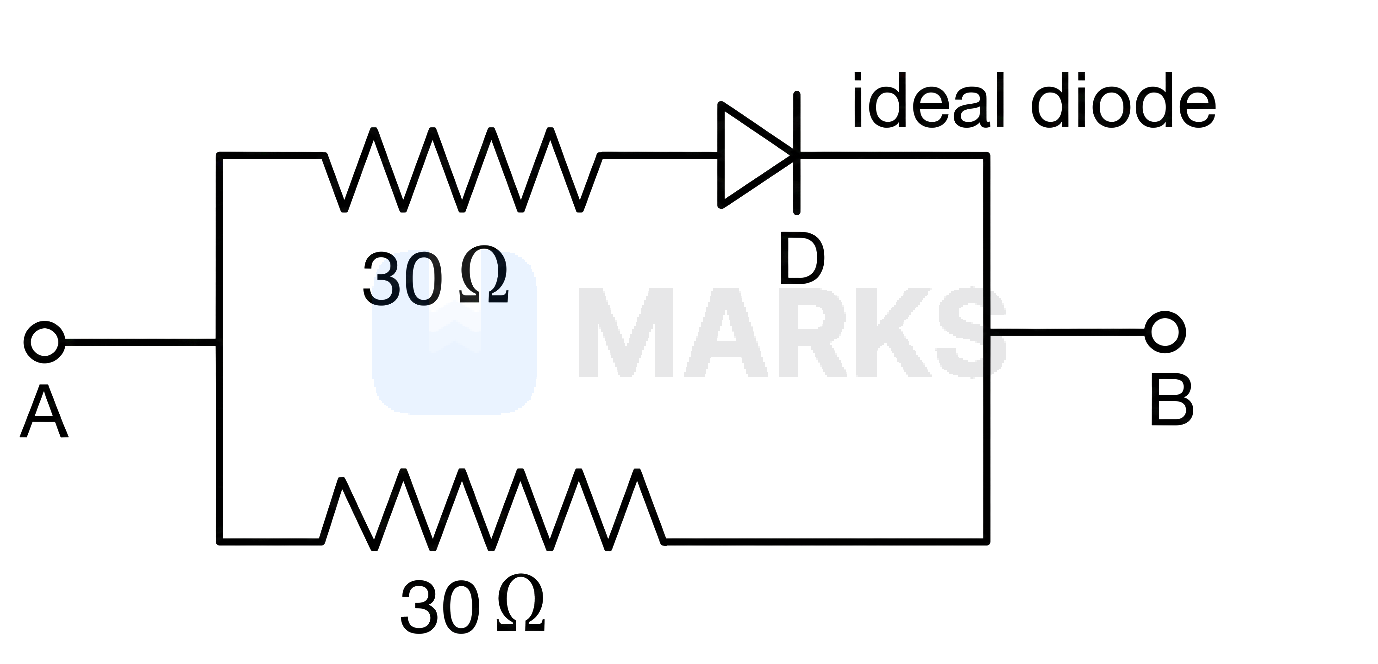
In the diagram shown, the resistance between points A and B is '$R_1$' when an ideal diode D is forward biased and is '$R_2$' when ideal diode D is reverse biased. The ratio $R_1 / R_2$ is
- A$2$
- B$1$
- Correct answerC$\dfrac{1}{2}$
- D$\dfrac{1}{4}$
Solution
When the ideal diode D is forward biased, it acts as a short circuit with zero resistance.
The circuit then consists of two $30\ \Omega$ resistors connected in parallel between points A and B.
The equivalent resistance $R_1$ is given by:
$R_1 = \dfrac{30 \times 30}{30 + 30} = 15\ \Omega$
When the ideal diode D is reverse biased, it acts as an open circuit with infinite resistance.
No current flows through the top branch, so the equivalent resistance $R_2$ is simply the resistance of the bottom branch.
$R_2 = 30\ \Omega$
The ratio $\dfrac{R_1}{R_2}$ is:
$\dfrac{R_1}{R_2} = \dfrac{15}{30} = \dfrac{1}{2}$
Answer: $\dfrac{1}{2}$
Hence, the correct answer is option: 'C'.