Q167 / 180 · COMEDK 2019 · Physics
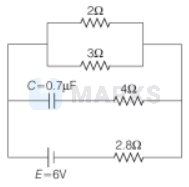
In the circuit shown, the internal resistance of the cell is negligible. The steady state current in the $2 \Omega 2$ resistor is
- Correct answerA$0.9 \mathrm{~A}$
- B$1.5 \mathrm{~A}$
- C$0.6 \mathrm{~A}$
- D$1.2 \mathrm{~A}$
Solution
In the steady state analysis capacitor acts as an open circuit. Therefore, the equivalent circuit is given as

Thus, current in the $4 \Omega$ resistor is zero. $2 \Omega$ and $3 \Omega$ resistors are parallel to each other. Thus, the resistance in the upper branch is given by $$ R=\frac{2 \times 3}{2+3}=\frac{6}{5} \Omega $$ The upper branch resistor are connected to $2.8 \Omega$ resistor in series. Therefore, equivalent resistance in the circuit is given by $$ \begin{aligned} R_{\mathrm{eq}} & \approx 28+\frac{6}{5} \\ &=\frac{14.0+6}{5}=4 \Omega \end{aligned} $$ Current, $I=\frac{\text { Voltage }}{\text { Resistance }}=\frac{6}{4}=15 \mathrm{~A}$ Current in the $2 \Omega$ resistor is given by current division rule $$ \begin{aligned} \text { i.e. } & I_{2 \Omega}=I \times \frac{3 \Omega}{2 \Omega+3 \Omega} \\ \Rightarrow \quad & I_{2 \Omega}=1.5 \times \frac{3}{5}=0.9 \mathrm{~A} \end{aligned} $$
Thus, current in the $4 \Omega$ resistor is zero. $2 \Omega$ and $3 \Omega$ resistors are parallel to each other. Thus, the resistance in the upper branch is given by $$ R=\frac{2 \times 3}{2+3}=\frac{6}{5} \Omega $$ The upper branch resistor are connected to $2.8 \Omega$ resistor in series. Therefore, equivalent resistance in the circuit is given by $$ \begin{aligned} R_{\mathrm{eq}} & \approx 28+\frac{6}{5} \\ &=\frac{14.0+6}{5}=4 \Omega \end{aligned} $$ Current, $I=\frac{\text { Voltage }}{\text { Resistance }}=\frac{6}{4}=15 \mathrm{~A}$ Current in the $2 \Omega$ resistor is given by current division rule $$ \begin{aligned} \text { i.e. } & I_{2 \Omega}=I \times \frac{3 \Omega}{2 \Omega+3 \Omega} \\ \Rightarrow \quad & I_{2 \Omega}=1.5 \times \frac{3}{5}=0.9 \mathrm{~A} \end{aligned} $$
Hence, the correct answer is option: 'A'.