Q31 / 54 · KVPY 2017 (5 Nov SA) · Mathematics
In an isosceles trapezium, the length of one of the parallel sides, and the leng ths of the non-parallelsides are all equal to 30 . In order to maximize the area of the trapezium, the smallest angle should be
- A$\frac{\pi}{6}$
- B$\frac{\pi}{4}$
- Correct answerC$\frac{\pi}{3}$
- D$\frac{\pi}{2}$
Solution
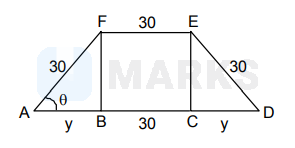
In $\triangle A B F, y=30 \cos \theta$ Area is $A=\frac{1}{2}[60+60 \cos \theta](30 \sin \theta)$ $\begin{array}{l} =30(1+\cos \theta)(30 \sin \theta) \\ =900(\sin \theta+\sin \theta \cos \theta) \end{array}$ For maximum or minimum $\begin{array}{l} \frac{d A}{d \theta}=900\left[\cos \theta+\left(-\sin ^{2} \theta+\cos ^{2} \theta\right)\right]=0 \\ \cos \theta-1+\cos ^{2} \theta+\cos ^{2} \theta=0 \\ 2 \cos ^{2} \theta+\cos \theta-1=0 \\ (2 \cos \theta-1)(\cos \theta+1)=0 \end{array}$ $\cos \theta=\frac{1}{2}$ or $\cos \theta=-1$ (not possible) $\theta=60^{\circ}$
Hence, the correct answer is option: 'C'.