Q170 / 200 · MHT CET - Medical 2026 (21 April Shift 1) · Physics
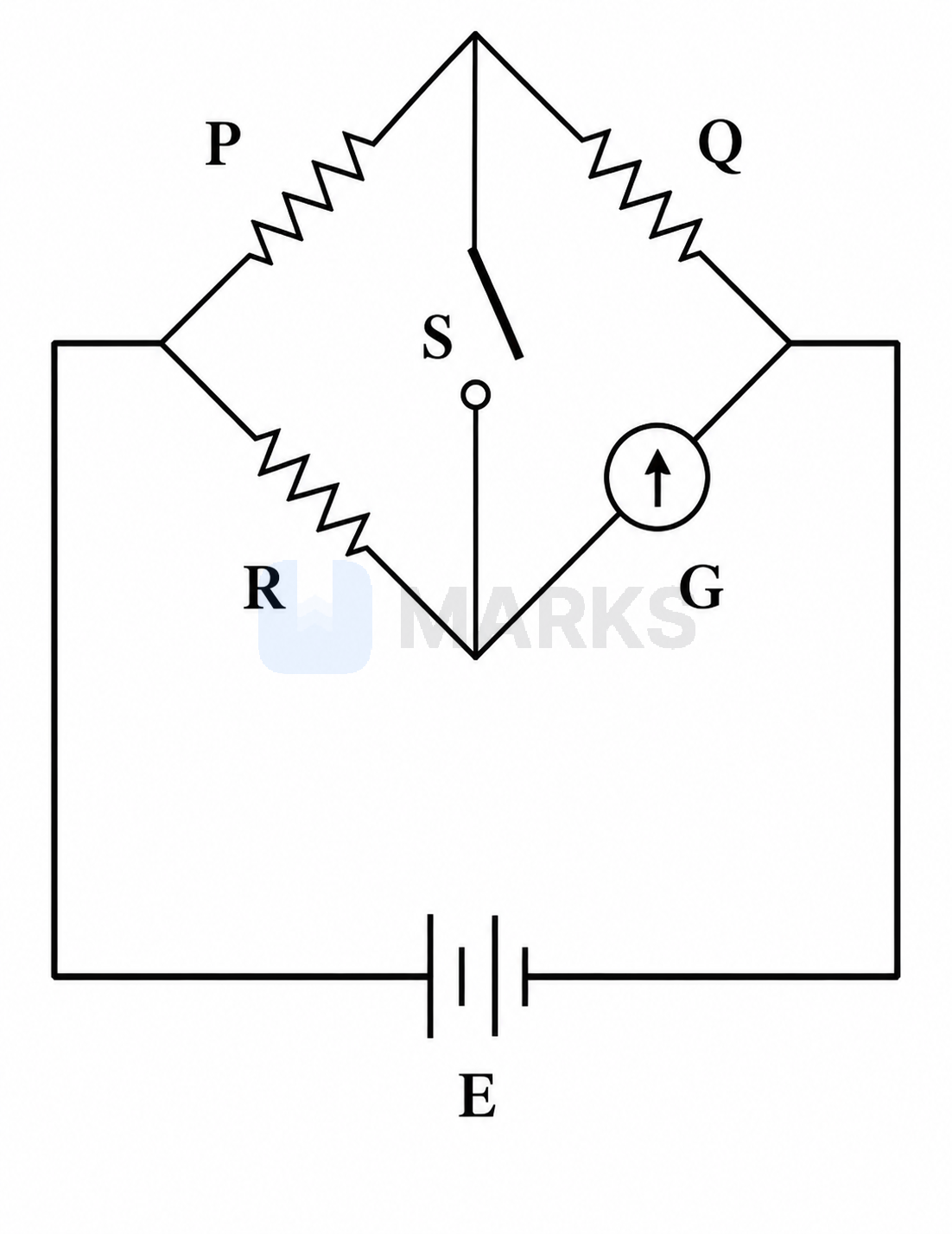
In a Wheatstone's network $P \neq R$, the reading of the galvanometer is the same with a switch 'S' open or closed. Then
- Correct answerA$I_R = I_G$
- B$I_P = I_G$
- C$I_Q = I_G$
- D$I_Q = I_R$
Solution
When the switch S is open, the resistor $R$ and the galvanometer $G$ are connected in series in the lower branch. Thus, the same current flows through both, giving $I_R = I_G$.
The galvanometer reading remains the same whether the switch is open or closed. This indicates that closing the switch does not alter the current in the galvanometer branch.
This condition occurs only if the potential difference across the switch is zero, which means the Wheatstone network is balanced ($\dfrac{P}{R} = \dfrac{Q}{G}$).
Since the bridge is balanced, no current flows through the central branch containing the switch S even when it is closed.
Because no current is diverted through the switch, the entire current flowing through resistor $R$ must continue to flow through the galvanometer $G$. Therefore, $I_R = I_G$ holds true in both states.
Given $P \neq R$, the total resistance of the upper branch ($P+Q$) is not equal to the lower branch ($R+G$). Consequently, the current in the upper branch ($I_P$) is not equal to the current in the lower branch ($I_R$ or $I_G$). This invalidates the other options. Answer : $I_R = I_G$
Hence, the correct answer is option: 'A'.