Q71 / 160 · TS EAMCET 2009 · Mathematics
In a quadrilateral $A B C D$, the point $P$ divides $D C$ in the ratio $1: 2$ and $Q$ is the mid point of $A C$. If $\overrightarrow{\mathbf{A B}}+2 \overrightarrow{\mathbf{A D}}+\overrightarrow{\mathbf{B C}}-2 \overrightarrow{\mathbf{D C}}=k \overrightarrow{\mathbf{P Q}}$, then $k$ is equal to
- Correct answerA-6
- B-4
- C6
- D4
Solution
Now, $\overrightarrow{\mathbf{A B}}+2 \overrightarrow{\mathbf{A D}}+\overrightarrow{\mathbf{B C}}-2 \overrightarrow{\mathbf{D C}}$
$=\overrightarrow{\mathbf{A C}}+2 \overrightarrow{\mathbf{A D}}-2 \overrightarrow{\mathbf{D C}}$
$=\overrightarrow{\mathbf{A C}}+2(\overrightarrow{\mathbf{A C}}+\overrightarrow{\mathbf{C D}})-2 \overrightarrow{\mathbf{D C}}$
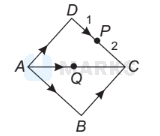
$\begin{aligned} & =3 \overrightarrow{\mathbf{A C}}-4 \overrightarrow{\mathbf{D C}} \\ & =3(2 \overrightarrow{\mathbf{Q C}})-4\left(\frac{3}{2} \overrightarrow{\mathbf{P C}}\right) \\ & =6 \overrightarrow{\mathbf{Q C}}-6 \overrightarrow{\mathbf{P C}}=6(\overrightarrow{\mathbf{Q C}}+\overrightarrow{\mathbf{C P}}) \end{aligned}$ $\Rightarrow \quad k \overrightarrow{\mathbf{P Q}}=6 \overrightarrow{\mathbf{Q P}}=-6 \overrightarrow{\mathbf{P Q}} \quad$ (given) $\Rightarrow \quad k=-6$
$\begin{aligned} & =3 \overrightarrow{\mathbf{A C}}-4 \overrightarrow{\mathbf{D C}} \\ & =3(2 \overrightarrow{\mathbf{Q C}})-4\left(\frac{3}{2} \overrightarrow{\mathbf{P C}}\right) \\ & =6 \overrightarrow{\mathbf{Q C}}-6 \overrightarrow{\mathbf{P C}}=6(\overrightarrow{\mathbf{Q C}}+\overrightarrow{\mathbf{C P}}) \end{aligned}$ $\Rightarrow \quad k \overrightarrow{\mathbf{P Q}}=6 \overrightarrow{\mathbf{Q P}}=-6 \overrightarrow{\mathbf{P Q}} \quad$ (given) $\Rightarrow \quad k=-6$
Hence, the correct answer is option: 'A'.