Q49 / 240 · KCET 2026 · Biology
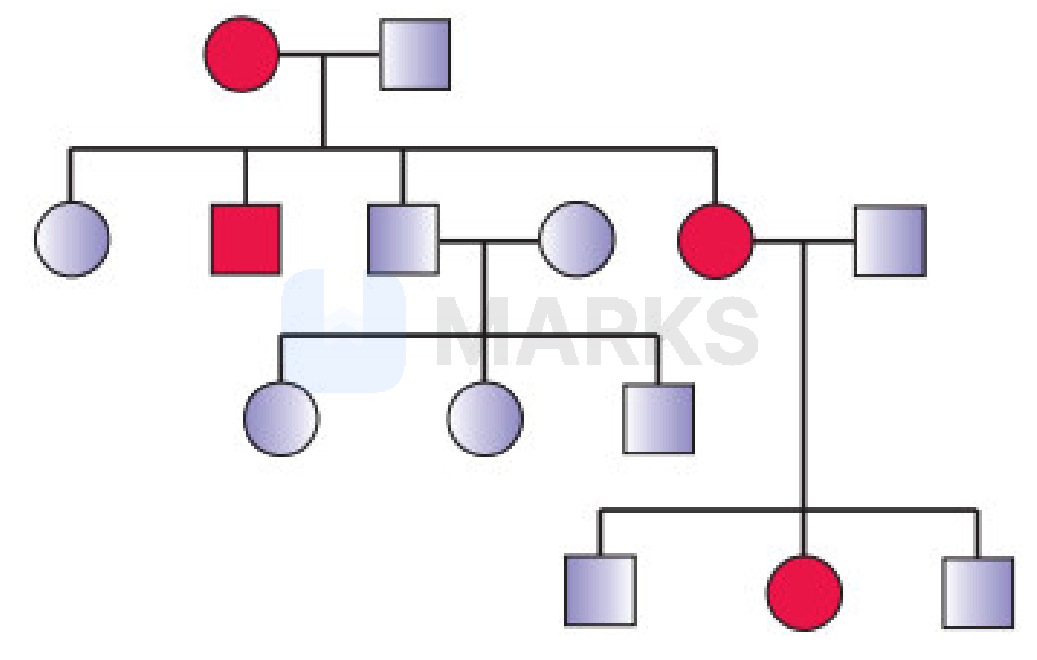
In a practical examination, the below given pedigree chart was given as spotter for identification. The students identified the pedigree chart as ____
- AAutosomal recessive
- Correct answerBAutosomal dominant
- CSex-linked dominant
- DSex-linked recessive
Solution
If the trait were sex-linked recessive, the affected mother in generation I would have only affected sons. Since she has an unaffected son in generation II, it is not sex-linked recessive.
The trait appears in all generations, indicating a dominant trait. Assuming it is autosomal dominant, let the affected allele be $A$ and the normal allele be $a$.
The affected female in generation I must be heterozygous ($Aa$) because she has unaffected offspring ($aa$). Her unaffected partner is $aa$.
The cross $Aa \times aa$ produces both affected ($Aa$) and unaffected ($aa$) offspring, which matches the observed progeny in generation II.
Similarly, the affected female in generation II ($Aa$) and her unaffected partner ($aa$) produce both affected ($Aa$) and unaffected ($aa$) offspring in generation III, consistent with the pedigree.
This is a classic textbook pedigree for an autosomal dominant trait like myotonic dystrophy.
Answer: Autosomal dominant
Hence, the correct answer is option: 'B'.