Q144 / 180 · NEET 2026 (Cancelled) · Physics
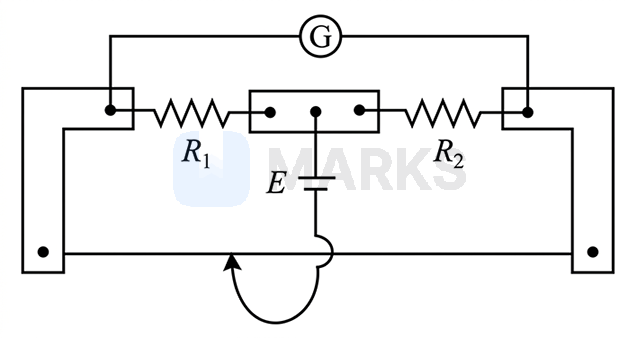
In a metre bridge experiment (see figure), the positions of the cell, $E$, and galvanometer, $G$, are interchanged. We shall observe in the galvanometer :
- AOnly the left-sided deflection
- BThere will be no deflection irrespective of the position of the jockey
- COnly the right-sided deflection
- Correct answerDBoth right-sided and left-sided deflection and at balance point, no deflection
Solution
Let the nodes of the circuit be identified as follows:
Node A: Left L-shaped metallic strip.
Node B: Right L-shaped metallic strip.
Node C: Central metallic strip.
Node D: The point on the wire where the jockey touches.
The resistances in the four arms of the circuit are:
1. Resistance between A and C is $R_1$.
2. Resistance between B and C is $R_2$.
3. Resistance between A and D is $R_{AD}$ (left part of the metre bridge wire).
4. Resistance between B and D is $R_{DB}$ (right part of the metre bridge wire).
In the given figure, the cell $E$ is connected between nodes C and D, and the galvanometer $G$ is connected between nodes A and B. This arrangement forms a Wheatstone bridge.
Let the potential at node D be $0$ and the potential at node C be $V$.
The current from the cell divides at node C into two parallel branches: C $\rightarrow$ A $\rightarrow$ D and C $\rightarrow$ B $\rightarrow$ D.
The potential at node A is given by the voltage divider rule:
$V_A = V \left( \dfrac{R_{AD}}{R_1 + R_{AD}} \right)$
Similarly, the potential at node B is:
$V_B = V \left( \dfrac{R_{DB}}{R_2 + R_{DB}} \right)$
The galvanometer shows no deflection when the potential difference across it is zero, i.e., $V_A = V_B$.
$\dfrac{R_{AD}}{R_1 + R_{AD}} = \dfrac{R_{DB}}{R_2 + R_{DB}}$
$\Rightarrow \dfrac{R_1 + R_{AD}}{R_{AD}} = \dfrac{R_2 + R_{DB}}{R_{DB}}$
$\Rightarrow \dfrac{R_1}{R_{AD}} + 1 = \dfrac{R_2}{R_{DB}} + 1$
$\Rightarrow \dfrac{R_1}{R_{AD}} = \dfrac{R_2}{R_{DB}}$
This is the standard balance condition for a Wheatstone bridge. Thus, interchanging the cell and the galvanometer does not affect the balance condition. A null point will still be obtained on the wire.
If the jockey is moved to the left of the balance point, $R_{AD}$ decreases and $R_{DB}$ increases, making $V_A < V_B$. Current will flow from B to A through the galvanometer, causing a deflection in one direction.
If the jockey is moved to the right of the balance point, $R_{AD}$ increases and $R_{DB}$ decreases, making $V_A > V_B$. Current will flow from A to B, causing a deflection in the opposite direction.
Therefore, the galvanometer will show both right-sided and left-sided deflections depending on the jockey's position, and no deflection at the balance point.
Answer: Both right-sided and left-sided deflection and at balance point, no deflection
Hence, the correct answer is option: 'D'.