Q89 / 120 · VITEEE 2009 · Physics
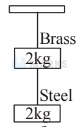
If the ratio of lengths, radii and Young's modulus of steel and brass wires shown in the figure are a, b and c respectively, the ratio between the increase in lengths of brass and steel wires would be
- A$\frac{b^{2} a}{2 c}$
- B$\frac{b c}{2 a^{2}}$
- C$\frac{b a^{2}}{2 c}$
- Correct answerD$\frac{a}{2 b^{2} c}$
Solution
Given, $\frac{l_{1}}{l_{2}}=a, \frac{r_{1}}{r_{2}}=b, \frac{Y_{1}}{Y_{2}}=c$
Free body diagram of the two blocks brass and steel are
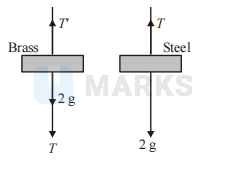
Let Young's modulus of steel is $Y_{1}$ and of brass is $Y_{2}$. $\therefore Y_{1}=\frac{F_{1} \cdot l_{1}}{A_{1} \cdot \Delta l_{1}}...(i)$ and $Y_{2}=\frac{F_{2} \cdot l_{2}}{A_{2} \cdot \Delta l_{2}}...(ii)$ Dividing Eq. (i) by(ii), $$ \begin{array}{l} \frac{Y_{1}}{Y_{2}}=\frac{\frac{F_{1} \cdot l_{1}}{A_{1} \cdot \Delta l_{1}}}{\frac{F_{2} \cdot l_{2}}{A_{2} \cdot \Delta l_{2}}} \\ \text { or } \frac{Y_{1}}{Y_{2}}=\frac{F_{1} \cdot A_{2} \cdot l_{1} \cdot \Delta l_{2}}{F_{2} \cdot A_{1} \cdot l_{2} \cdot \Delta l_{1}}...(ii) \end{array} $$ Force on steel wire from free body diagram $T=F_{1}=(2 g)$ newton Force on brass wire from free body diagram $F_{2}=T^{\prime}=T+2 g=(4 g)$ newton Now, putting the value of $F_{1}, F_{2}$, in Eq. (iii), we get $$ \frac{Y_{1}}{Y_{2}}=\left(\frac{2 g}{4 g}\right) \cdot\left(\frac{\pi r_{2}^{2}}{\pi r_{1}^{2}}\right) \cdot\left[\frac{l_{1}}{l_{2}}\right] \cdot\left(\frac{\Delta l_{2}}{\Delta l_{1}}\right) $$ or $c=\frac{1}{2}\left(\frac{1}{b^{2}}\right) \cdot a\left(\frac{\Delta l_{2}}{\Delta l_{1}}\right)$ or $\frac{\Delta l_{1}}{\Delta l_{2}}=\left(\frac{a}{2 b^{2} c}\right)$
Let Young's modulus of steel is $Y_{1}$ and of brass is $Y_{2}$. $\therefore Y_{1}=\frac{F_{1} \cdot l_{1}}{A_{1} \cdot \Delta l_{1}}...(i)$ and $Y_{2}=\frac{F_{2} \cdot l_{2}}{A_{2} \cdot \Delta l_{2}}...(ii)$ Dividing Eq. (i) by(ii), $$ \begin{array}{l} \frac{Y_{1}}{Y_{2}}=\frac{\frac{F_{1} \cdot l_{1}}{A_{1} \cdot \Delta l_{1}}}{\frac{F_{2} \cdot l_{2}}{A_{2} \cdot \Delta l_{2}}} \\ \text { or } \frac{Y_{1}}{Y_{2}}=\frac{F_{1} \cdot A_{2} \cdot l_{1} \cdot \Delta l_{2}}{F_{2} \cdot A_{1} \cdot l_{2} \cdot \Delta l_{1}}...(ii) \end{array} $$ Force on steel wire from free body diagram $T=F_{1}=(2 g)$ newton Force on brass wire from free body diagram $F_{2}=T^{\prime}=T+2 g=(4 g)$ newton Now, putting the value of $F_{1}, F_{2}$, in Eq. (iii), we get $$ \frac{Y_{1}}{Y_{2}}=\left(\frac{2 g}{4 g}\right) \cdot\left(\frac{\pi r_{2}^{2}}{\pi r_{1}^{2}}\right) \cdot\left[\frac{l_{1}}{l_{2}}\right] \cdot\left(\frac{\Delta l_{2}}{\Delta l_{1}}\right) $$ or $c=\frac{1}{2}\left(\frac{1}{b^{2}}\right) \cdot a\left(\frac{\Delta l_{2}}{\Delta l_{1}}\right)$ or $\frac{\Delta l_{1}}{\Delta l_{2}}=\left(\frac{a}{2 b^{2} c}\right)$
Hence, the correct answer is option: 'D'.