Q89 / 160 · TS EAMCET 2020 (14 Sep Shift 2) · Mathematics
If the parametric equations of the circle passing through the points $(3,4),(3,2)$ and $(1,4)$ is $x=a+r \cos \theta, y=b+r \sin \theta$, then $b^a r^a=$
- A27
- Correct answerB18
- C9
- D54
Solution
A circle is passing through $(3,4),(3,2)$ and $(1,4)$.
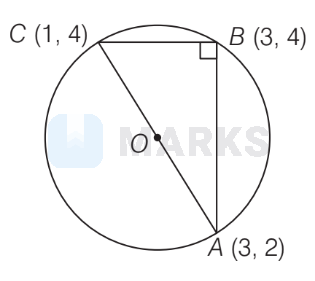
Clearly, $\triangle A B C$ is a right angle triangle $-$ centre of circle is mid-point of $A C$ i.e., $O(2,3)$ $r=A O=\sqrt{(3-2)^2+(2-3)^2}=\sqrt{1+1}=\sqrt{2}$ Equation of circle in parameter form is $\begin{aligned} & x=2+\sqrt{2} \cos \theta \Rightarrow y=3+\sqrt{2} \sin \theta \\ & \therefore \quad a=2, b=3, r=\sqrt{2} \\ & b^a \cdot r^a=(3)^2(\sqrt{2})^2=9 \times 2=18 \\ & \end{aligned}$
Clearly, $\triangle A B C$ is a right angle triangle $-$ centre of circle is mid-point of $A C$ i.e., $O(2,3)$ $r=A O=\sqrt{(3-2)^2+(2-3)^2}=\sqrt{1+1}=\sqrt{2}$ Equation of circle in parameter form is $\begin{aligned} & x=2+\sqrt{2} \cos \theta \Rightarrow y=3+\sqrt{2} \sin \theta \\ & \therefore \quad a=2, b=3, r=\sqrt{2} \\ & b^a \cdot r^a=(3)^2(\sqrt{2})^2=9 \times 2=18 \\ & \end{aligned}$
Hence, the correct answer is option: 'B'.