Q87 / 160 · AP EAMCET 2019 (20 Apr Shift 2) · Mathematics
If the pairs of straight lines represented by $3 x^2+2 h x y-3 y^2=0$ and $3 x^2+2 h x y-3 y^2+2 x-4 y+c=0$ form a square, then $(h, c)=$
- Correct answerA$(4,-1)$
- B$(-1,4)$
- C$(-4,1)$
- D$(1,-4)$
Solution
Given, equations of pair of straight lines

both represents pair of perpendicular lines. Now, the point of intersection the lines given by $a x^2+2 h x y+b y^2+2 g x+2 f y+c=0$ is $\left(\frac{h f-b g}{a b-h^2}, \frac{g h-a f}{a b-h^2}\right)$, So for the pair of lines (ii), the point of intersection is $$ \begin{aligned} & A\left(\frac{h(-2)-(-3)(1)}{-9-h^2}, \frac{h-3(-2)}{-9-h^2}\right) \\ & =A\left(\frac{2 h-3}{9+h^2},-\frac{h+6}{9+h^2}\right) \end{aligned} $$ The equation of diagonal of square passes through
and the equation of diagonal of square not passes
The diagonals given by the Eqs. (iii) and (iv) are perpendicular if $$ \begin{array}{ll} & \frac{1}{2}\left(\frac{h+6}{3-2 h}\right)=-1 \\ \Rightarrow & h+6=4 h-6 \\ \Rightarrow & 3 h=12 \\ \Rightarrow & h=4 \end{array} $$ So, point $A=\left(\frac{8-3}{9+16},-\frac{10}{9+16}\right)=\left(\frac{1}{5},-\frac{2}{5}\right)$ And the line (iv) passes through the mid-point ' $M$ 'of line joining points $A\left(\frac{1}{5},-\frac{2}{5}\right)$ and $O(0,0)$. So, $M=\left(\frac{1}{10},-\frac{1}{5}\right)$.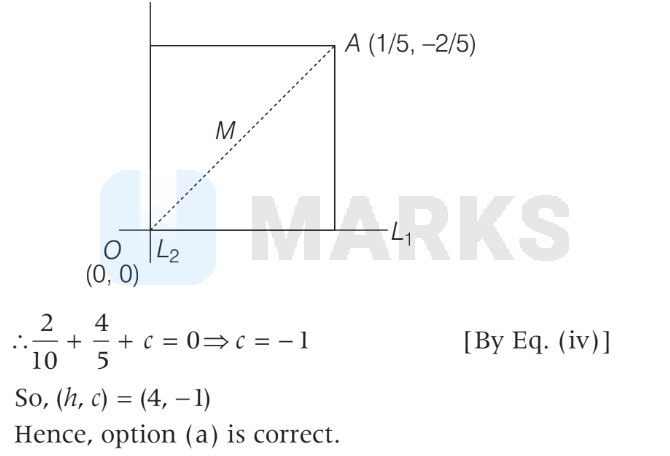
both represents pair of perpendicular lines. Now, the point of intersection the lines given by $a x^2+2 h x y+b y^2+2 g x+2 f y+c=0$ is $\left(\frac{h f-b g}{a b-h^2}, \frac{g h-a f}{a b-h^2}\right)$, So for the pair of lines (ii), the point of intersection is $$ \begin{aligned} & A\left(\frac{h(-2)-(-3)(1)}{-9-h^2}, \frac{h-3(-2)}{-9-h^2}\right) \\ & =A\left(\frac{2 h-3}{9+h^2},-\frac{h+6}{9+h^2}\right) \end{aligned} $$ The equation of diagonal of square passes through
and the equation of diagonal of square not passes
The diagonals given by the Eqs. (iii) and (iv) are perpendicular if $$ \begin{array}{ll} & \frac{1}{2}\left(\frac{h+6}{3-2 h}\right)=-1 \\ \Rightarrow & h+6=4 h-6 \\ \Rightarrow & 3 h=12 \\ \Rightarrow & h=4 \end{array} $$ So, point $A=\left(\frac{8-3}{9+16},-\frac{10}{9+16}\right)=\left(\frac{1}{5},-\frac{2}{5}\right)$ And the line (iv) passes through the mid-point ' $M$ 'of line joining points $A\left(\frac{1}{5},-\frac{2}{5}\right)$ and $O(0,0)$. So, $M=\left(\frac{1}{10},-\frac{1}{5}\right)$.
Hence, the correct answer is option: 'A'.