Q103 / 170 · Manipal (MET) 2016 · Mathematics
If $\theta$ is the semi-vertical angle of a cone of maximum volume and given slant height, then $\tan \theta$ is given by
- A$2$
- B$1$
- Correct answerC$\sqrt{2}$
- D$\sqrt{3}$
Solution
Volume of cone, $V=\frac{\pi}{3} r^2 h$
$\Rightarrow \quad V=\frac{\pi}{3} r^2 \sqrt{1^2-r^2}$
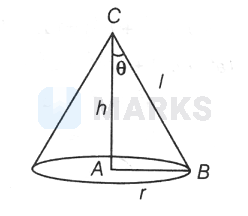
On differentiating w.r.t. $I$, we get $\frac{d V}{d r}=\frac{\pi}{3}\left[2 r \sqrt{1^2-r^2}+\frac{r^2}{2 \sqrt{1^2-r^2}}(-2 r)\right]$ Put $\quad \frac{d V}{d r}=0$, we get$r= \pm 1 \sqrt{\frac{2}{3}}$ At$r=1 \sqrt{\frac{2}{3}}, \frac{d^2 V}{d r^2} \lt 0,$ (maximum) $\therefore \quad h=\sqrt{I^2-\frac{2}{3} l^2}=\frac{1}{\sqrt{3}}$ In $\triangle A B C, \tan \theta=\frac{r}{h}=\frac{1 \sqrt{\frac{2}{3}}}{1 / \sqrt{3}}=\sqrt{2}$
On differentiating w.r.t. $I$, we get $\frac{d V}{d r}=\frac{\pi}{3}\left[2 r \sqrt{1^2-r^2}+\frac{r^2}{2 \sqrt{1^2-r^2}}(-2 r)\right]$ Put $\quad \frac{d V}{d r}=0$, we get$r= \pm 1 \sqrt{\frac{2}{3}}$ At$r=1 \sqrt{\frac{2}{3}}, \frac{d^2 V}{d r^2} \lt 0,$ (maximum) $\therefore \quad h=\sqrt{I^2-\frac{2}{3} l^2}=\frac{1}{\sqrt{3}}$ In $\triangle A B C, \tan \theta=\frac{r}{h}=\frac{1 \sqrt{\frac{2}{3}}}{1 / \sqrt{3}}=\sqrt{2}$
Hence, the correct answer is option: 'C'.