Q202 / 270 · NDA 2024 (Phase 1) · Mathematics
If $(1,-1,2)$ and $(2,1,-1)$ are the end points of a diameter of a sphere $x^2+y^2+z^2+2 u x+$ $2 v y+2 w z-1=0$, then what is $u+v+w$ equal to?
- Correct answerA-2
- B-1
- C1
- D2
Solution
The general equation $x^2+y^2+z^2+2 u x+2 v y+2 w z+d=0$ represents a sphere with centre
$(-u,-v,-w)$ and radius $r=\sqrt{u^2+v^2+w^2-d}$
If $B$ is the mid point of the line segment $A C$ where $\mathrm{A}=\left(x_1, y_1, z_1\right)$ and $\mathrm{C}=\left(x_2, y_2, z_2\right)$ then.
$\mathrm{B}=\left(\frac{x_1+x_2}{2}, \frac{y_1+y_2}{2}, \frac{z_1+z_2}{2}\right)$
Given, equation of sphere $x^2+y^2+z^2+2 u x+$ $2 v y+2 w z-1=0$ with AB as its diameter and $\mathrm{A}=(1,-1,2)$ and $\mathrm{B}=(2,1,-1)$
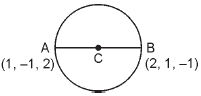
$\begin{aligned} \mathrm{C} & =\left(\frac{1+2}{2}, \frac{1-1}{2}, \frac{-1+2}{2}\right) \\ & =\left(\frac{3}{2}, 0, \frac{1}{2}\right) \end{aligned}$ We know that centre of the sphere is given by $(-u,-v,-w)$ Comparing, then we get, $\left(\frac{3}{2}, 0, \frac{1}{2}\right)=(-u,-v,-w)$ $\begin{aligned} u & =-\frac{3}{2}, v=0, w=-\frac{1}{2} \\ \therefore u+v+w & =-\frac{3}{2}+0-\frac{1}{2}=-\frac{4}{2}=-2\end{aligned}$
$\begin{aligned} \mathrm{C} & =\left(\frac{1+2}{2}, \frac{1-1}{2}, \frac{-1+2}{2}\right) \\ & =\left(\frac{3}{2}, 0, \frac{1}{2}\right) \end{aligned}$ We know that centre of the sphere is given by $(-u,-v,-w)$ Comparing, then we get, $\left(\frac{3}{2}, 0, \frac{1}{2}\right)=(-u,-v,-w)$ $\begin{aligned} u & =-\frac{3}{2}, v=0, w=-\frac{1}{2} \\ \therefore u+v+w & =-\frac{3}{2}+0-\frac{1}{2}=-\frac{4}{2}=-2\end{aligned}$
Hence, the correct answer is option: 'A'.