Q102 / 180 · KCET 2012 · Mathematics
If $\mathbf{i}+\mathbf{j}-\mathbf{k}$ and $2 \mathbf{i}-3 \mathbf{j}+\mathbf{k}$ are adjacent sides of a parallelogram, then the lengths of its diagonals are
- A$\sqrt{3}, \sqrt{14}$
- B$\sqrt{13}, \sqrt{14}$
- C$\sqrt{21}, \sqrt{3}$
- Correct answerD$\sqrt{21}, \sqrt{13}$
Solution
$\begin{array}{ll}\text { Let } & \mathbf{A B}=\mathbf{i}+\mathbf{j}-\mathbf{k} \\ \text { and } & \mathbf{B C}=2 \mathbf{i}-3 \mathbf{j}+\mathbf{k}\end{array}$
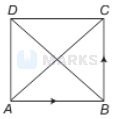
The diagonal $\mathbf{A C}=\mathbf{A B}+\mathbf{B C}$ $$ \begin{aligned} &=(\mathbf{i}+\mathbf{j}-\mathbf{k})+(2 \mathbf{i}-3 \mathbf{j}+\mathbf{k}) \\ &=3 \mathbf{i}-2 \mathbf{j} \end{aligned} $$ The length of diagonal $$ \mathbf{A C}=\sqrt{(3)^{2}+(-2)^{2}}=\sqrt{9+4}=\sqrt{13} $$ The diagonal $\mathbf{D B}=\mathbf{A B}-\mathbf{A D}$ $$ \begin{aligned} &=(\mathbf{i}+\mathbf{j}-\mathbf{k})-(2 \mathbf{i}-3 \mathbf{j}+\mathbf{k}) \\ &=-\mathbf{i}+4 \mathbf{j}-2 \mathbf{k} \end{aligned} $$ The length of diagonal $$ \text { DB }=\sqrt{1+16+4}=\sqrt{21} $$
The diagonal $\mathbf{A C}=\mathbf{A B}+\mathbf{B C}$ $$ \begin{aligned} &=(\mathbf{i}+\mathbf{j}-\mathbf{k})+(2 \mathbf{i}-3 \mathbf{j}+\mathbf{k}) \\ &=3 \mathbf{i}-2 \mathbf{j} \end{aligned} $$ The length of diagonal $$ \mathbf{A C}=\sqrt{(3)^{2}+(-2)^{2}}=\sqrt{9+4}=\sqrt{13} $$ The diagonal $\mathbf{D B}=\mathbf{A B}-\mathbf{A D}$ $$ \begin{aligned} &=(\mathbf{i}+\mathbf{j}-\mathbf{k})-(2 \mathbf{i}-3 \mathbf{j}+\mathbf{k}) \\ &=-\mathbf{i}+4 \mathbf{j}-2 \mathbf{k} \end{aligned} $$ The length of diagonal $$ \text { DB }=\sqrt{1+16+4}=\sqrt{21} $$
Hence, the correct answer is option: 'D'.