Q40 / 180 · COMEDK 2026 (9 May Shift 1) · Chemistry
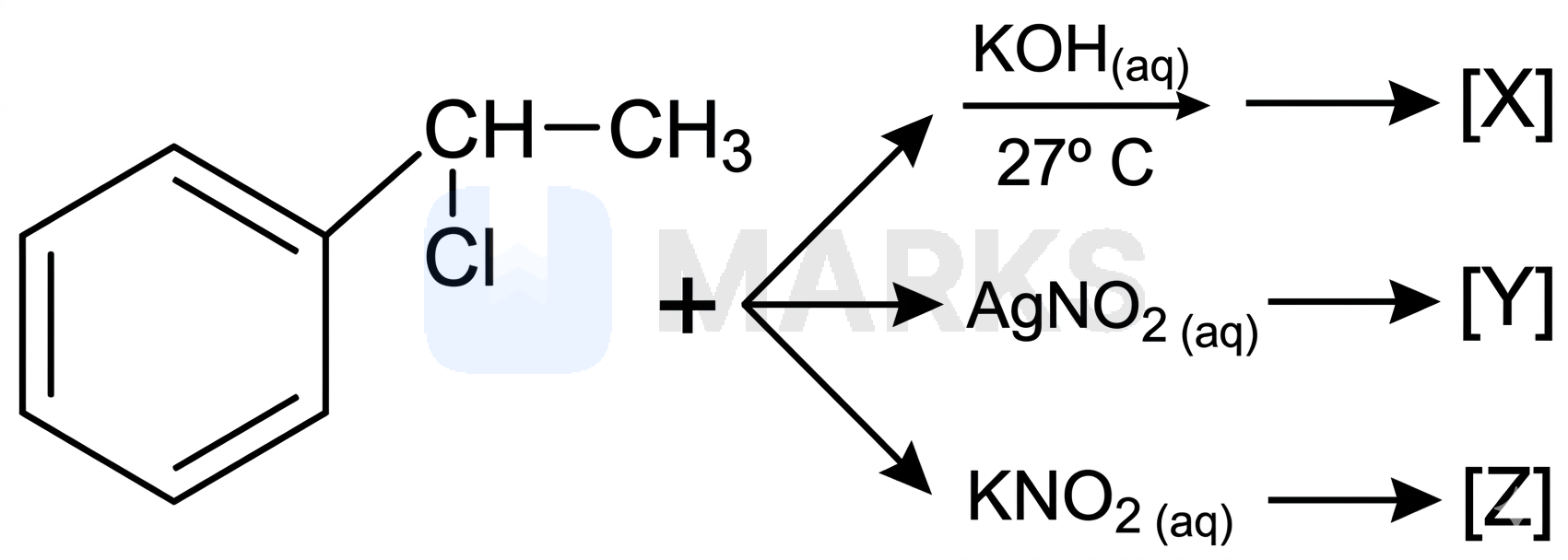
Identify X, Y and Z.
- A

- B

- Correct answerC

- D

Solution
The reactant is 1-chloro-1-phenylethane.
Aqueous $\text{KOH}$ acts as a nucleophile and undergoes a substitution reaction with the alkyl halide to form an alcohol. Therefore, [X] is 1-phenylethanol, $\text{C}_6\text{H}_5\text{CH(OH)CH}_3$.
Silver nitrite ($\text{AgNO}_2$) is a predominantly covalent compound. The lone pair on the nitrogen atom attacks the electrophilic carbon, leading to the formation of a nitroalkane. Therefore, [Y] is (1-nitroethyl)benzene, $\text{C}_6\text{H}_5\text{CH(NO}_2\text{)CH}_3$.
Potassium nitrite ($\text{KNO}_2$) is an ionic compound, providing the nitrite ion ($\text{NO}_2^-$) where the oxygen atom carries a negative charge and acts as the nucleophile. This leads to the formation of an alkyl nitrite. Therefore, [Z] is 1-phenylethyl nitrite, $\text{C}_6\text{H}_5\text{CH(O-N=O)CH}_3$.
Answer:
Hence, the correct answer is option: 'C'.