Q11 / 160 · AP EAMCET 2019 (20 Apr Shift 2) · Chemistry
Identify the correct statements from the following
I. $\mathrm{B}_2 \mathrm{H}_6$ is an electron deficient hydride.
II. $\mathrm{NH}_3$ an electron rich hydride.
III. $\mathrm{NaH}$ is a covalent hydride.
IV. $\mathrm{YbH}_{255}$ is an interstitial hydride.
- AI, II, III
- BII, III, IV
- Correct answerCI, II, IV
- DI, III, IV
Solution
(I) $\mathrm{B}_2 \mathrm{H}_6$ (diborane) is an electron deficient hydride. This can be explained on the basis of structure given below.
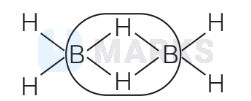
$3 \mathrm{C}-2 e^{-}$electron deficient bridge bond (II) $\mathrm{NH}_3$ is electron rich hydride due to presence of lone pair of electrons.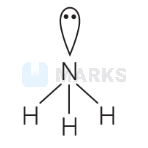
(III) $\mathrm{NaH}$ is an ionic hydride, generally hydride of alkali metals are ionic. Hence, statement III is incorrect. (IV) $\mathrm{YbH}_{2.55}$ is an interstitial hydride. Here, smaller atom like hydrogen present in interstitial space of $\mathrm{Yb}$ metal. Hence, it forms interstitial hydride. Thus, option (c) is correct.
$3 \mathrm{C}-2 e^{-}$electron deficient bridge bond (II) $\mathrm{NH}_3$ is electron rich hydride due to presence of lone pair of electrons.
(III) $\mathrm{NaH}$ is an ionic hydride, generally hydride of alkali metals are ionic. Hence, statement III is incorrect. (IV) $\mathrm{YbH}_{2.55}$ is an interstitial hydride. Here, smaller atom like hydrogen present in interstitial space of $\mathrm{Yb}$ metal. Hence, it forms interstitial hydride. Thus, option (c) is correct.
Hence, the correct answer is option: 'C'.