Q37 / 155 · WBJEE 2019 · Chemistry
Identify the correct statement(s):
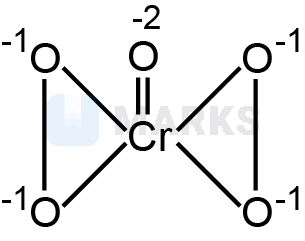
- Correct answerAThe oxidation number of $\mathrm{Cr}$ in $\mathrm{CrO}_{5}$ is +6
- Correct answerB$\Delta H>\Delta U$ for the reaction $N_{2} O_{4}(g) \rightarrow 2 N O_{2}(g)$ provided both gases behave ideally.
- C$\mathrm{pH}$ of $0.1 \mathrm{N} \mathrm{H}_{2} \mathrm{SO}_{4}$ is less than that of $0.1 \mathrm{N} \mathrm{HC}$ at $25^{\circ} \mathrm{C}$
- D$\left(\frac{R T}{F}\right)=0.0591$ volt at $25^{\circ} \mathrm{C}$
Solution
In $\mathrm{CrO}_{5}$ oxidation no. of $\mathrm{Cr}$ is +6.
 (b) For the reaction (in ideal case)
$$
\begin{array}{r}
\mathrm{N}_{2} \mathrm{O}_{4}(g) \longrightarrow 2 \mathrm{NO}_{2}(g) \\
\Delta H=\Delta U+p \cdot \Delta V
\end{array}
$$
$\because \quad \Delta H=\Delta U+\Delta n_{g} R T$
$\left(\because p \Delta V=\Delta n_{g} R T\right)$
Where, $\Delta n_{g}=$ (gaseous moles of product)-(gaseous moles of reactant)
$$
\Delta n_{g}=2-1=1
$$
Thus, $\Delta H>\Delta U$
(c) ${p H}$ of $0.1 \mathrm{N} \mathrm{H}_{2} \mathrm{SO}_{4}$ is less than of $0.1 \mathrm{HCl}$ at
$25^{\circ}$ is a wrong statement.
$\mathrm{pH}$ of $\mathrm{H}_{2} \mathrm{SO}_{4}$
$$
\because \mathrm{pH}=-\log \left[\mathrm{H}^{+}\right]=-\log \left[\mathrm{l} 0^{-2}\right]
$$
$\because \quad(N=C \times Z)$ and $\left(Z=2\right.$ for $\left.\mathrm{H}_{2} \mathrm{SO}_{4}\right)$
$\mathrm{pH}=2$ and $\mathrm{pH}$ of $\mathrm{HCl}$
$$
\mathrm{pH}=-\log \left[\mathrm{l} 0^{-1}\right]=1
$$
Thus, $\mathrm{pH}$ of $\mathrm{H}_{2} \mathrm{SO}_{4}>\mathrm{pH}$ of $\mathrm{HCl}$.
(d) $\frac{R T}{F}=0.0591$ at $25^{\circ} \mathrm{C}$ is a wrong statement.
Where, $R=$ Gas constant $=8.314$
$T=$ Temperature $=273+25=298 \mathrm{K}$
$F=$ Charge over one mole of electrons
$=96500 \mathrm{C}$
Thus, $\frac{R T}{F}=\frac{8.314 \times 298}{96500}=0.02567$
The correct value is $\frac{2.303 R T}{F}=0.0591$
Hence, only option and (b) are correct.
(b) For the reaction (in ideal case)
$$
\begin{array}{r}
\mathrm{N}_{2} \mathrm{O}_{4}(g) \longrightarrow 2 \mathrm{NO}_{2}(g) \\
\Delta H=\Delta U+p \cdot \Delta V
\end{array}
$$
$\because \quad \Delta H=\Delta U+\Delta n_{g} R T$
$\left(\because p \Delta V=\Delta n_{g} R T\right)$
Where, $\Delta n_{g}=$ (gaseous moles of product)-(gaseous moles of reactant)
$$
\Delta n_{g}=2-1=1
$$
Thus, $\Delta H>\Delta U$
(c) ${p H}$ of $0.1 \mathrm{N} \mathrm{H}_{2} \mathrm{SO}_{4}$ is less than of $0.1 \mathrm{HCl}$ at
$25^{\circ}$ is a wrong statement.
$\mathrm{pH}$ of $\mathrm{H}_{2} \mathrm{SO}_{4}$
$$
\because \mathrm{pH}=-\log \left[\mathrm{H}^{+}\right]=-\log \left[\mathrm{l} 0^{-2}\right]
$$
$\because \quad(N=C \times Z)$ and $\left(Z=2\right.$ for $\left.\mathrm{H}_{2} \mathrm{SO}_{4}\right)$
$\mathrm{pH}=2$ and $\mathrm{pH}$ of $\mathrm{HCl}$
$$
\mathrm{pH}=-\log \left[\mathrm{l} 0^{-1}\right]=1
$$
Thus, $\mathrm{pH}$ of $\mathrm{H}_{2} \mathrm{SO}_{4}>\mathrm{pH}$ of $\mathrm{HCl}$.
(d) $\frac{R T}{F}=0.0591$ at $25^{\circ} \mathrm{C}$ is a wrong statement.
Where, $R=$ Gas constant $=8.314$
$T=$ Temperature $=273+25=298 \mathrm{K}$
$F=$ Charge over one mole of electrons
$=96500 \mathrm{C}$
Thus, $\frac{R T}{F}=\frac{8.314 \times 298}{96500}=0.02567$
The correct value is $\frac{2.303 R T}{F}=0.0591$
Hence, only option and (b) are correct.Hence, the correct answer is options: 'A', 'B'.