Q52 / 180 · COMEDK 2025 (10 May Shift 1) · Chemistry
Identify the compound which gives an optically active haloalkane on reaction with $\mathrm{H}_2$ / Ni on heating.
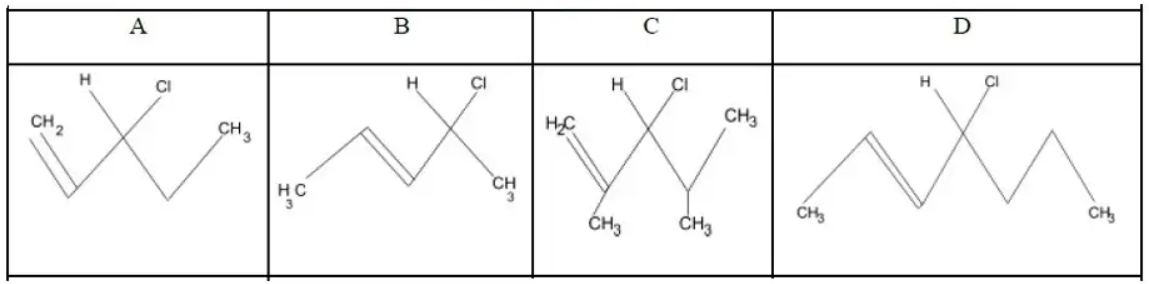
- AC
- BD
- Correct answerCB
- DA
Solution
$H_2$/Ni reduces the double bond to give a haloalkane. The product is optically active only if it contains a chiral centre (4 different groups on the Cl-bearing carbon).
A (3-chloropent-1-ene): Reduction gives 3-chloropentane. Cl-bearing carbon has two identical $-CH_2CH_3$ groups. Achiral — optically inactive.
B (4-chloropent-2-ene): Reduction gives 2-chloropentane. Cl-bearing carbon has $-H$, $-Cl$, $-CH_3$, and $-CH_2CH_2CH_3$ — four different groups. Chiral centre — optically active.
C (3-chloro-2,4-dimethylpent-1-ene): Reduction gives 3-chloro-2,4-dimethylpentane. Cl-bearing carbon has two identical $-CH(CH_3)_2$ groups. Achiral — optically inactive.
D (4-chlorohept-2-ene): Reduction gives 4-chloroheptane. Cl-bearing carbon has two identical $-CH_2CH_2CH_3$ groups. Achiral — optically inactive.
Only compound B gives an optically active haloalkane.
Hence, the correct answer is option: 'C'.