Q177 / 200 · Manipal (MET) 2014 · Physics
Given,
$\begin{array}{ll}
R_1=1 \Omega & C_1=2 \mu \mathrm{~F} \\
R_2=2 \Omega & C_2=4 \mu \mathrm{~F}
\end{array}$
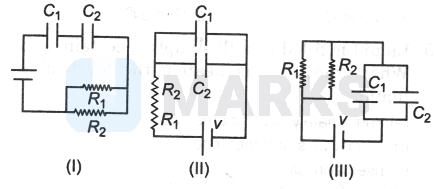
The time constant (in $\mu \mathrm{s}$ ) for the circuits I, II, III are respectively
The time constant (in $\mu \mathrm{s}$ ) for the circuits I, II, III are respectively
- A$18,8 / 9,4$
- B$18,4,8 / 9$
- C$4,8 / 9,18$
- Correct answerD$8 / 9,18,4$
Solution
For (I): The net capacitance \(\mathrm{C}=\frac{\mathrm{C}_1 \mathrm{C}_2}{\mathrm{C}_1+\mathrm{C}_2}=\frac{2 \times 4}{2+4}=4 / 3 \mu \mathrm{~F}\) and net resistance
\(\mathrm{R}=\frac{\mathrm{R}_1 \mathrm{R}_2}{\mathrm{R}_1+\mathrm{R}_2}=\frac{1 \times 2}{1+2}=2 / 3 \Omega\)
Thus, time constant \(\tau=\mathrm{CR}=(4 / 3)(2 / 3)=(8 / 9) \mu \mathrm{S}\)
For (II): \(\mathrm{C}=\mathrm{C}_1+\mathrm{C}_2=2+4=6 \mu \mathrm{~F}\) and \(\mathrm{R}=\mathrm{R}_1+\mathrm{R}_2=1+2=3 \Omega\)
Thus, time constant \(\tau=\mathrm{CR}=(6)(3)=18 \mu \mathrm{~S}\)
For (III): \(\mathrm{C}=\mathrm{C}_1+\mathrm{C}_2=2+4=6 \mu \mathrm{~F}\) and \(\mathrm{R}=\frac{\mathrm{R}_1 \mathrm{R}_2}{\mathrm{R}_1+\mathrm{R}_2}=2 / 3 \Omega\)
Thus, time constant \(\tau=\mathrm{CR}=(6)(2 / 3)=4 \mu \mathrm{~S}\)
Hence, the correct answer is option: 'D'.