Q131 / 160 · TS EAMCET 2020 (09 Sep Shift 2) · Physics
From a uniform circular disc of radius $2 \mathrm{~cm}$ (its centre of mass is at $O$ ) a circular portion of radius $1 \mathrm{~cm}$ is removed such that the shift in centre of mass is maximum. The disc is
now rotated by an angle $\theta$ about an axis perpendicular to its plane and passing through $O$. If the magnitude of displacement of new centre of mass is $\frac{1}{\sqrt{3}} \mathrm{~cm}$, then the $\theta$ is
- A$30^{\circ}$
- B$45^{\circ}$
- C$60^{\circ}$
- Correct answerD$120^{\circ}$
Solution
The situation given can be shown as,
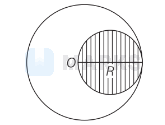
Here, $R$ be the radius of circular disc $=2 \mathrm{~cm}$ The radius of removed portion, $r=1 \mathrm{~cm}$ Area of whole disc, $A_1=\pi R^2=4 \pi \mathrm{cm}^2$ Area of removed portion, $A_2=\pi r^2=\pi \mathrm{cm}^2$ As, $\frac{1}{4}$ th area of the disc is removed, so remaining area of the disc is $\frac{3}{4}$ th initial area. Similarly, remaining mass, $m_1=\frac{3}{4} m$ Mass of removed portion, $m_2=\frac{1}{4} m$ Let $x$ be the maximum shift in centre of mass. So, initially centre of mass along $X$-axis of complete disc, $\begin{aligned} x_{\mathrm{CM}} & =\frac{m_1 x+m_2 r}{m_1+m_2} \\ 0 & =\frac{\frac{3}{4} m x+\frac{1}{4} m r}{\frac{3}{4} m+\frac{1}{4} m}\end{aligned}$ $\Rightarrow \quad \frac{3}{4} m x=-\frac{1}{4} m r$ or $x=-\frac{1}{3} r=-\frac{1}{3} \mathrm{~cm}$ i.e., the centre of mass of remaining portion will shift to the left of origin at $\frac{1}{3} \mathrm{~cm}$. Now, the disc is rotated by angle $\theta$, so the centre of mass will also shift by angle $\theta$ as shown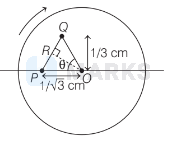
$\triangle O P Q$ is isoscales. So, a perpendicular drawn from $O$, on $P Q$ divide the angle $\theta$ and length $P Q$ in equal parts i.e., $R Q=\frac{1}{2} P Q=\frac{1}{2}\left(\frac{1}{\sqrt{3}}\right) \mathrm{cm} \quad\left(\right.$ given, $\left.P Q=\frac{1}{\sqrt{3}}\right)$ From $\triangle O R Q$, $\begin{array}{rlrl} & & \sin \frac{\theta}{2}=\frac{R Q}{O Q}=\frac{\frac{1}{2} \times \frac{1}{\sqrt{3}}}{\frac{1}{3}} \\ \Rightarrow \quad & \sin \frac{\theta}{2}=\frac{\sqrt{3}}{2}=\sin 60^{\circ} \\ \Rightarrow \quad & \theta=120^{\circ}\end{array}$
Here, $R$ be the radius of circular disc $=2 \mathrm{~cm}$ The radius of removed portion, $r=1 \mathrm{~cm}$ Area of whole disc, $A_1=\pi R^2=4 \pi \mathrm{cm}^2$ Area of removed portion, $A_2=\pi r^2=\pi \mathrm{cm}^2$ As, $\frac{1}{4}$ th area of the disc is removed, so remaining area of the disc is $\frac{3}{4}$ th initial area. Similarly, remaining mass, $m_1=\frac{3}{4} m$ Mass of removed portion, $m_2=\frac{1}{4} m$ Let $x$ be the maximum shift in centre of mass. So, initially centre of mass along $X$-axis of complete disc, $\begin{aligned} x_{\mathrm{CM}} & =\frac{m_1 x+m_2 r}{m_1+m_2} \\ 0 & =\frac{\frac{3}{4} m x+\frac{1}{4} m r}{\frac{3}{4} m+\frac{1}{4} m}\end{aligned}$ $\Rightarrow \quad \frac{3}{4} m x=-\frac{1}{4} m r$ or $x=-\frac{1}{3} r=-\frac{1}{3} \mathrm{~cm}$ i.e., the centre of mass of remaining portion will shift to the left of origin at $\frac{1}{3} \mathrm{~cm}$. Now, the disc is rotated by angle $\theta$, so the centre of mass will also shift by angle $\theta$ as shown
$\triangle O P Q$ is isoscales. So, a perpendicular drawn from $O$, on $P Q$ divide the angle $\theta$ and length $P Q$ in equal parts i.e., $R Q=\frac{1}{2} P Q=\frac{1}{2}\left(\frac{1}{\sqrt{3}}\right) \mathrm{cm} \quad\left(\right.$ given, $\left.P Q=\frac{1}{\sqrt{3}}\right)$ From $\triangle O R Q$, $\begin{array}{rlrl} & & \sin \frac{\theta}{2}=\frac{R Q}{O Q}=\frac{\frac{1}{2} \times \frac{1}{\sqrt{3}}}{\frac{1}{3}} \\ \Rightarrow \quad & \sin \frac{\theta}{2}=\frac{\sqrt{3}}{2}=\sin 60^{\circ} \\ \Rightarrow \quad & \theta=120^{\circ}\end{array}$
Hence, the correct answer is option: 'D'.