Q185 / 200 · MHT CET - Medical 2026 (24 April Shift 1) · Physics
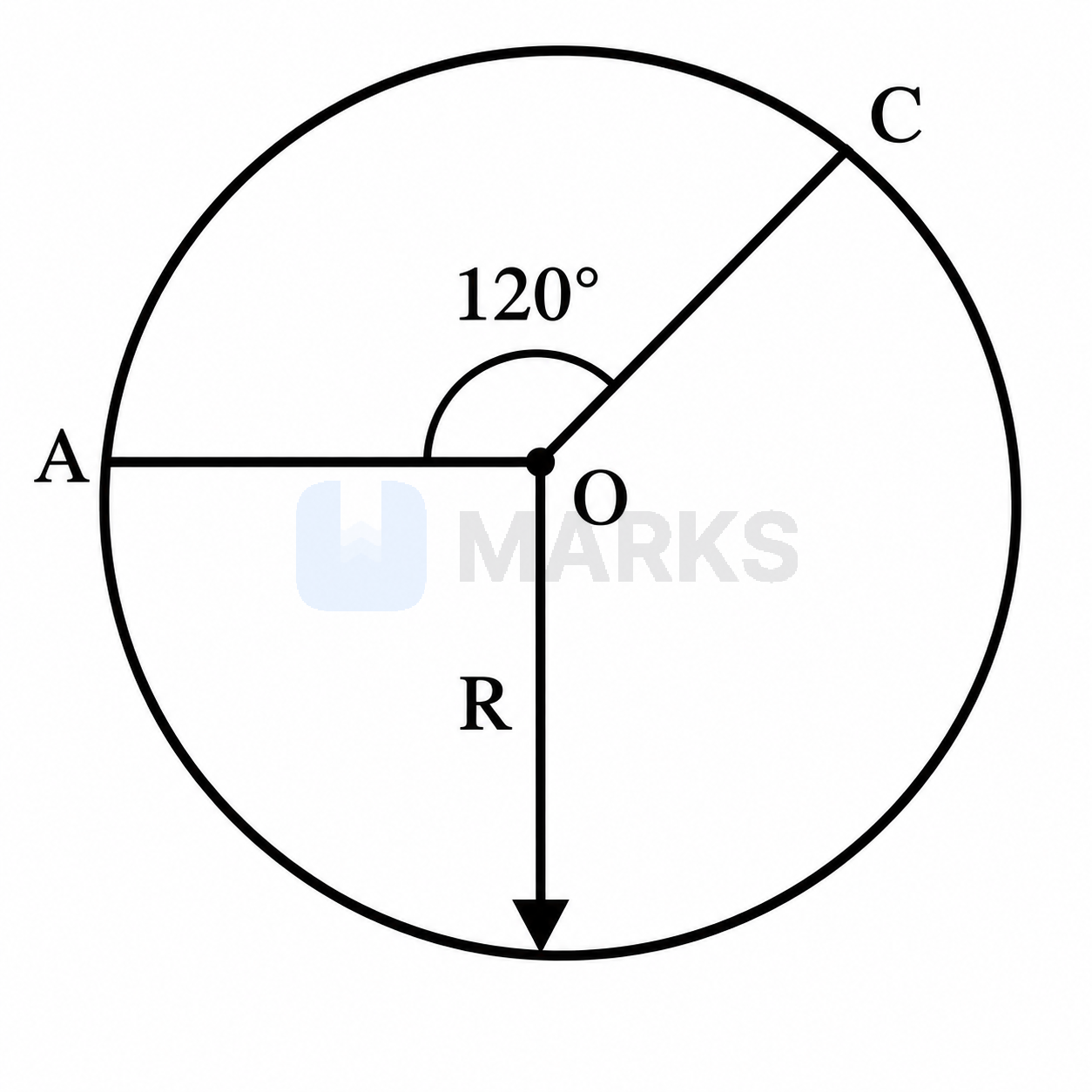
From a uniform circular disc of mass M and R, part AOC is removed as shown in the figure. The M.I. of the remaining portion of the disc about an axis passing through the centre and perpendicular to the plane of the disc is
- Correct answerA$\dfrac{MR^{2}}{3}$
- B$\dfrac{MR^{2}}{9}$
- C$\dfrac{MR^{2}}{6}$
- D$\dfrac{MR^{2}}{12}$
Solution
Let the mass of the complete uniform circular disc be $M$ and its radius be $R$.
The moment of inertia of the complete disc about an axis passing through its centre and perpendicular to its plane is:
$I_{total} = \dfrac{1}{2}MR^2$
The removed sector AOC subtends an angle of $120^{\circ}$ at the centre. The fraction of the disc that is removed is:
$\text{Fraction removed} = \dfrac{120^{\circ}}{360^{\circ}} = \dfrac{1}{3}$
Since the disc is uniform, the moment of inertia is directly proportional to the mass (and thus the angle) for a given radius. The moment of inertia of the removed portion is:
$I_{removed} = \dfrac{1}{3} I_{total} = \dfrac{1}{3} \left(\dfrac{1}{2}MR^2\right) = \dfrac{1}{6}MR^2$
The moment of inertia of the remaining portion is the difference between the total moment of inertia and the moment of inertia of the removed portion:
$I_{remaining} = I_{total} - I_{removed}$
$I_{remaining} = \dfrac{1}{2}MR^2 - \dfrac{1}{6}MR^2$
$I_{remaining} = \left(\dfrac{3 - 1}{6}\right)MR^2 = \dfrac{2}{6}MR^2 = \dfrac{1}{3}MR^2$
Alternatively, the mass of the remaining portion is $M' = \dfrac{2}{3}M$. The moment of inertia of a sector of a disc is $\dfrac{1}{2} \times \text{mass} \times \text{radius}^2$.
$I_{remaining} = \dfrac{1}{2}M'R^2 = \dfrac{1}{2}\left(\dfrac{2}{3}M\right)R^2 = \dfrac{1}{3}MR^2$
Answer: $\dfrac{MR^{2}}{3}$
Hence, the correct answer is option: 'A'.