Q97 / 120 · VITEEE 2016 · Physics
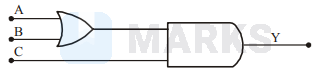
For what value of $\mathrm{A}, \mathrm{B}$ and $\mathrm{C}$, the output $\mathrm{Y}=1$
- A001
- Correct answerB101
- C100
- D010
Solution
Clearly,
$$
\mathrm{Y}=(\mathrm{A}+\mathrm{B}) \cdot \mathrm{C}=(\mathrm{A} \cdot \mathrm{C})+(\mathrm{B} \cdot \mathrm{C})
$$
For
$$
\begin{array}{ll}
\mathrm{A}=0, \mathrm{~B}=0 \& \mathrm{C}=1, & \mathrm{Y}=(0.1)+(0.1)=0 \\
\mathrm{~A}=1, \mathrm{~B}=0 \& \mathrm{C}=1, & \mathrm{Y}=(1.1)+(0.1)=1 \\
\mathrm{~A}=1, \mathrm{~B}=0 \& \mathrm{C}=0, & \mathrm{Y}=(0.1)+(0.0)=0 \\
\mathrm{~A}=0, \mathrm{~B}=1 \& \mathrm{C}=0, & \mathrm{Y}=(0.0)+(1.0)=0
\end{array}
$$
So, option (b) is correct.
Hence, the correct answer is option: 'B'.