Q64 / 75 · JEE Main 2026 (23 January Shift 2) · Physics
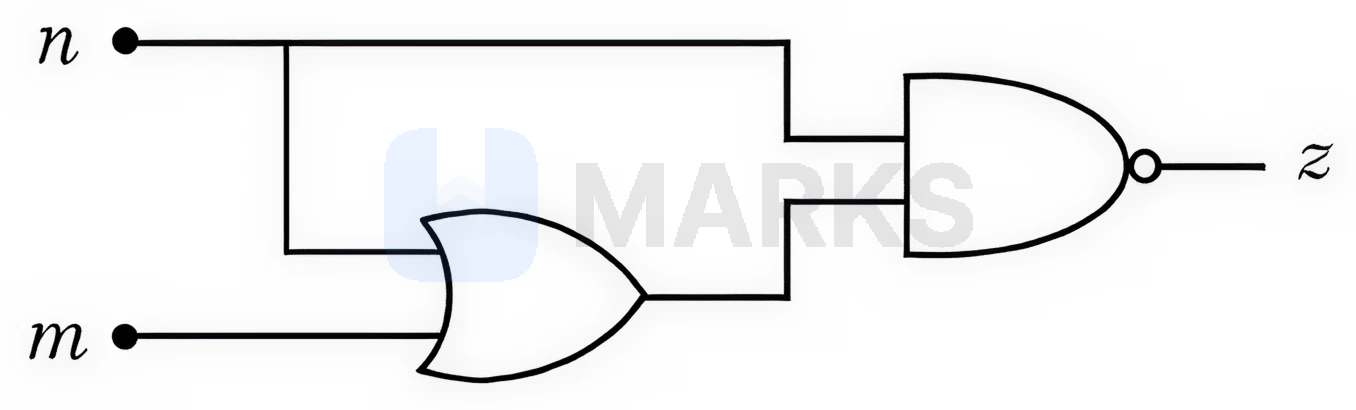
For the given logic gate circuit, which of the following is the correct truth table?
- A\(\begin{array}{c|c|c} n & m & z \\ \hline 0 & 0 & 0 \\ 0 & 1 & 1 \\ 1 & 1 & 0 \\ 1 & 0 & 1 \end{array}\)
- B\(\begin{array}{c|c|c} n & m & z \\ \hline 0 & 0 & 1 \\ 0 & 1 & 0 \\ 1 & 1 & 1 \\ 1 & 0 & 0 \end{array}\)
- C\(\begin{array}{c|c|c} n & m & z \\ \hline 0 & 0 & 1 \\ 0 & 1 & 0 \\ 1 & 1 & 0 \\ 1 & 0 & 0 \end{array}\)
- Correct answerD\(\begin{array}{c|c|c} n & m & z \\ \hline 0 & 0 & 1 \\ 0 & 1 & 1 \\ 1 & 1 & 0 \\ 1 & 0 & 0 \end{array}\)
Solution
The given logic circuit consists of an OR gate and a NAND gate.
The output of the OR gate is $y = n + m$.
The inputs to the NAND gate are $n$ and $y$.
The final output $z$ is given by $z = \overline{n \cdot y} = \overline{n \cdot (n + m)}$.
Using Boolean algebra: $n \cdot (n + m) = n \cdot n + n \cdot m = n + n \cdot m = n(1 + m) = n$.
Therefore, $z = \overline{n}$.
Let's verify this with the truth table:
Comparing this with the given options, option (4) matches the calculated truth table.
The output of the OR gate is $y = n + m$.
The inputs to the NAND gate are $n$ and $y$.
The final output $z$ is given by $z = \overline{n \cdot y} = \overline{n \cdot (n + m)}$.
Using Boolean algebra: $n \cdot (n + m) = n \cdot n + n \cdot m = n + n \cdot m = n(1 + m) = n$.
Therefore, $z = \overline{n}$.
Let's verify this with the truth table:
| n | m | y = n + m | z = NAND(n, y) |
|---|---|---|---|
| 0 | 0 | 0 | 1 |
| 0 | 1 | 1 | 1 |
| 1 | 1 | 1 | 0 |
| 1 | 0 | 1 | 0 |
Comparing this with the given options, option (4) matches the calculated truth table.
Hence, the correct answer is option: 'D'.