Q56 / 155 · WBJEE 2021 · Mathematics
For $x \in R, x \neq-1$, if $(1+x)^{2016}+x(1+x)^{2015}+x^{2}(1+x)^{2014}+\ldots \ldots .+x^{2016}=\sum_{i=0}^{2016} a_{i} \cdot x^{i}$, then $a_{17}$ is equal to
- A$\frac{2016 !}{17 ! 1999 !}$
- B$\frac{2016 !}{16 !}$
- C$\frac{2017 !}{2000 !}$
- Correct answerD$\frac{2017 !}{17 ! 2000 !}$
Solution
$\begin{aligned} \mathrm{a}_{17} &=\text { coeffn of } \mathrm{x}^{17} \\ &={ }^{2016} \mathrm{C}_{17}+{ }^{2015} \mathrm{C}_{16}+{ }^{2014} \mathrm{C}_{15}+\cdots++{ }^{1999} \mathrm{C}_{0} \\ &={ }^{2016} \mathrm{C}_{1999}+{ }^{2015} \mathrm{C}_{1999}+{ }^{2014} \mathrm{C}_{1999}+\cdots+{ }^{1999} \mathrm{C}_{1999} \end{aligned}$
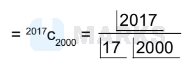
Hence, the correct answer is option: 'D'.