Q65 / 180 · NEET 2019 (Odisha) · Chemistry
Following limiting molar conductivities are given as given as
$$
\begin{aligned}
& \lambda_{\mathrm{m}\left(\mathrm{H}_2 \mathrm{SO}_4\right)}^0=\mathrm{x} \mathrm{S} \mathrm{cm}{ }^2 \mathrm{~mol}^{-1} \\
& \lambda_{\mathrm{m}\left(\mathrm{K}_2 \mathrm{SO}_4\right)}^0=\mathrm{y} \mathrm{S} \mathrm{cm}{ }^2 \mathrm{~mol}^{-1} \\
&
\end{aligned}
$$
$\lambda_{\mathrm{m}\left(\mathrm{CH}_2 \mathrm{COOK}\right)}^0=\mathrm{Z} \mathrm{S} \mathrm{cm}{ }^2 \mathrm{~mol}^{-1}$
- A$x-y+2 z$
- B$x+y-z$
- C$x-y+z$
- Correct answerD$\frac{(x-y)}{2}+z$
Solution
Key Idea According to Kohlrausch's law,
$$
\lambda_m^0 \text { for } A_x B_y=x \lambda_{(A)^{0+}}^0+y \lambda_{(B)^{x-}}
$$
where, $\lambda_m^{\circ}=$ limiting molar conductivity of electrolyte and $\lambda_{(A)^{y+}}^0$ and $\lambda_{(B)^{x-}}^0$ are the limiting molar conductivities of cation $\left(A^{y+}\right)$ and anion $\left(B^{x-}\right)$, respectively.
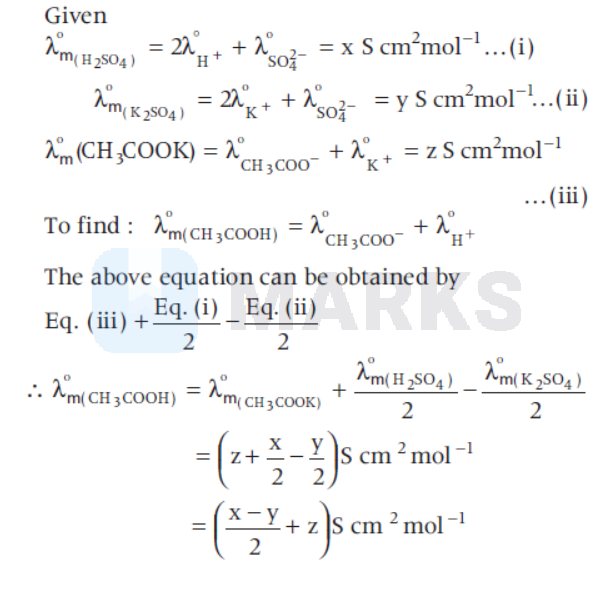
Hence, the correct answer is option: 'D'.