Q104 / 150 · MHT CET 2026 (11 April Shift 1) · Physics
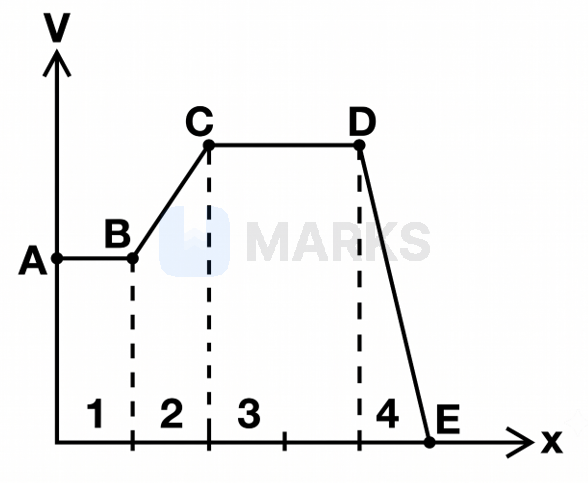
Following figure indicates the electric potential V as a function through 4 regions on x-axis. Which of the following is correct for the electric field E in these regions?
- A$E_1 < E_2 < E_3 < E_4$
- B$E_2 = E_4$ and $E_1 < E_2$
- Correct answerC$E_1 = E_3$ and $E_2 < E_4$
- D$E_1 > E_2 > E_3 > E_4$
Solution
The relation between electric field $E$ and electric potential $V$ is given by $E = -\dfrac{dV}{dx}$.
The magnitude of the electric field is equal to the magnitude of the slope of the $V-x$ graph.
In regions 1 and 3, the potential $V$ is constant. Therefore, the slope is zero, which means $E_1 = 0$ and $E_3 = 0$. Thus, $E_1 = E_3$.
In region 2, the magnitude of the electric field is $E_2 = \left| \dfrac{\Delta V}{\Delta x} \right| = \dfrac{V_C - V_B}{x_C - x_B}$.
In region 4, the magnitude of the electric field is $E_4 = \left| \dfrac{\Delta V}{\Delta x} \right| = \dfrac{V_D - V_E}{x_E - x_D} = \dfrac{V_C - 0}{x_E - x_D}$.
From the given graph, the horizontal widths of regions 2 and 4 are equal, i.e., $x_C - x_B = x_E - x_D$.
Since $V_B > 0$, the change in potential in region 4 ($V_C$) is greater than the change in potential in region 2 ($V_C - V_B$).
Therefore, the slope in region 4 is steeper than in region 2, which implies $E_4 > E_2$.
Combining these observations, we get $E_1 = E_3$ and $E_2 < E_4$.
Answer: $E_1 = E_3$ and $E_2 < E_4$
Hence, the correct answer is option: 'C'.