Q114 / 180 · AIIMS 2010 · Physics
Five sinusoidal waves have the same frequency $500 \mathrm{~Hz}$ but their amplitudes are in the ratio $2: \frac{1}{2}: \frac{1}{2}: 1: 1$ and their phase angles $0, \frac{\pi}{6}, \frac{\pi}{3}, \frac{\pi}{2}$ and $\pi$ respectively. The phase angle of resultant wave obtained by the superposition of these five waves is
- A$30^{\circ}$
- Correct answerB$45^{\circ}$
- C$60^{\circ}$
- D$90^{\circ}$
Solution
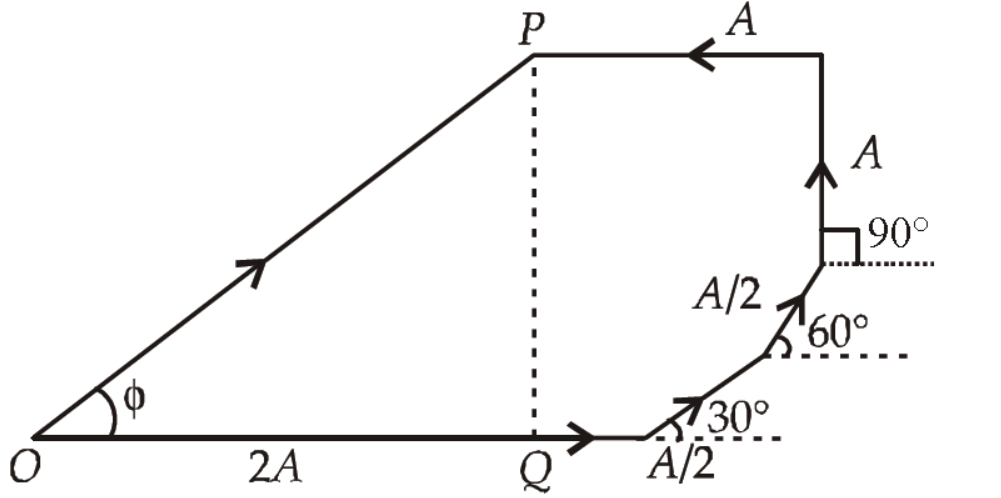
$$ \begin{aligned} & y_1=2 A \sin \omega t ; y_2=\frac{A}{2} \sin \left(\omega t+\frac{\pi}{6}\right) \\ & y_3=\frac{A}{2} \sin \left(\omega t+\frac{\pi}{3}\right) ; y_4=A \sin \left(\omega t+\frac{\pi}{2}\right) \\ & y_5=A \sin (\omega t+\pi) \end{aligned} $$ By phasor diagram, $\tan \phi=\frac{P Q}{O Q}=1$ $$ \Rightarrow \phi=45^{\circ} $$
Hence, the correct answer is option: 'B'.