Q46 / 180 · AIIMS 2004 · Chemistry
Dimethyl glyoxime gives a red precipitate with $\mathrm{Ni}^{2+}$, which is used for its detection. To get this precipitate readily the best $\mathrm{pH}$ range is
- A$ < 1$
- B$2-3$
- C$3-4$
- Correct answerD$9-11$.
Solution
Nickel(II) forms a precipitate with the organic compound dimethylglyoxime, $\mathrm{C}_4 \mathrm{H}_6(\mathrm{NOH})_2$. The formation of the red chelate occurs quantitatively in a solution in which the $\mathrm{pH}$ is buffered in the range of 5 to 9 . The chelation reaction that occurs is illustrated below.
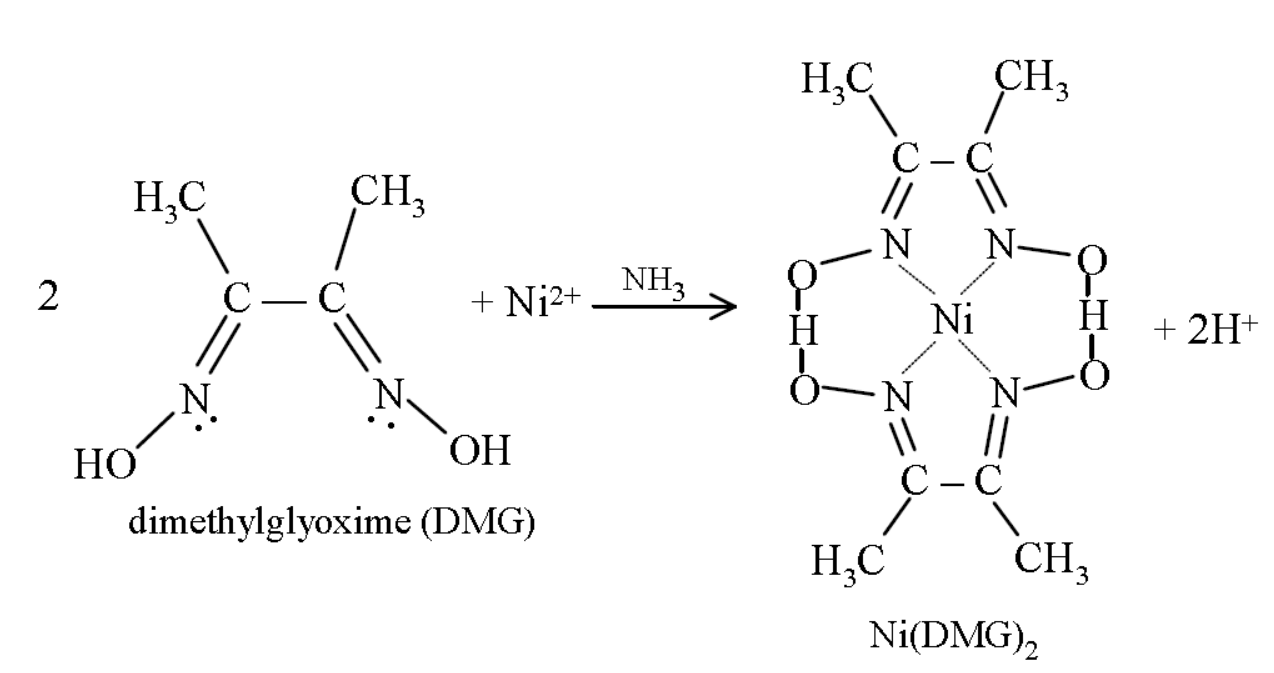
The reaction is performed in a solution buffered by either an ammonia or citrate buffer to prevent the $\mathrm{pH}$ of the solution from falling below 5 . If the $\mathrm{pH}$ does become too low the equilibrium of the above reaction favors the formation of nickel(II) ion, causing the dissolution of $\mathrm{Ni}(\mathrm{DMG})_2$ back into the mother liquor.
The reaction is performed in a solution buffered by either an ammonia or citrate buffer to prevent the $\mathrm{pH}$ of the solution from falling below 5 . If the $\mathrm{pH}$ does become too low the equilibrium of the above reaction favors the formation of nickel(II) ion, causing the dissolution of $\mathrm{Ni}(\mathrm{DMG})_2$ back into the mother liquor.
Hence, the correct answer is option: 'D'.