Q41 / 54 · JEE Advanced 2026 (Paper 2) · Physics
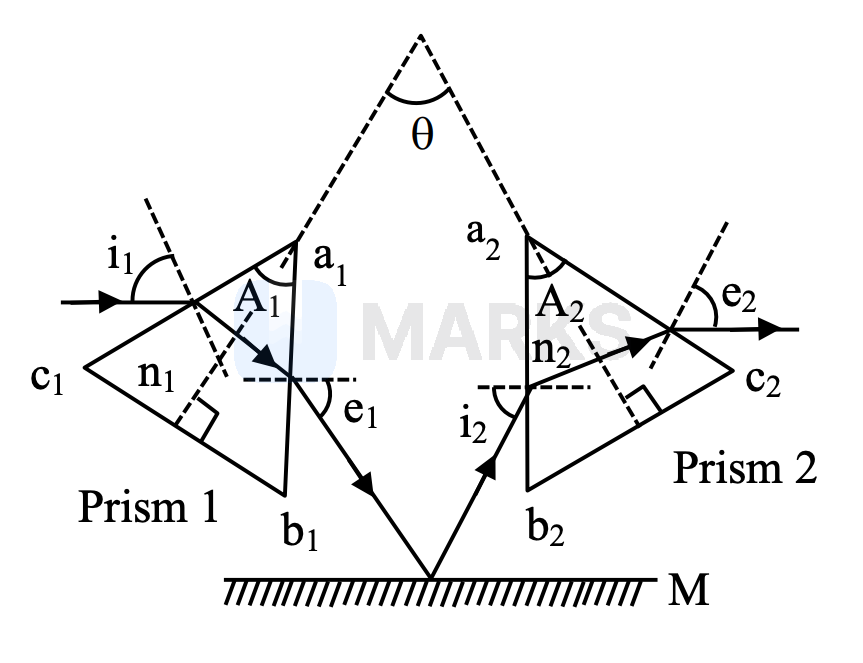
Consider two isosceles prisms 1 and 2 with prism angles $A_1$ and $A_2$ and refractive indices $n_1$ and $n_2$, respectively, as shown in the figure. The faces $a_1 b_1$ and $a_2 b_2$ are parallel to each other and perpendicular to the mirror $M$. If a ray of light is incident on the face $a_1 c_1$ and emerges from the face $a_2 c_2$, then the correct statement(s) is/are:
- Correct answerAIf both the prisms are at minimum deviation condition, then $\dfrac{n_2}{n_1} = \sin\left(\dfrac{A_1}{2}\right) / \sin\left(\dfrac{A_2}{2}\right)$.
- BIf prism 2 is at minimum deviation condition, then $\sin i_1 = n_2 \sin\left(\dfrac{A_2}{2}\right)$ is always true.
- Correct answerCIf both the prisms 1 and 2 are thin and are at minimum deviation condition with angles of deviation $\delta_{m1}$ and $\delta_{m2}$, respectively, then $\theta = \dfrac{\delta_{m1}}{2(n_1 - 1)} + \dfrac{\delta_{m2}}{2(n_2 - 1)}$.
- Correct answerDIf prism 1 is at minimum deviation condition, then $\sin i_2 = n_1 \sin\left(\dfrac{A_1}{2}\right)$ is always true.
Solution
From the given geometry, faces $a_1b_1$ and $a_2b_2$ are parallel to each other and perpendicular to the horizontal mirror $M$. Thus, $a_1b_1$ and $a_2b_2$ are vertical.
The normal to $a_1b_1$ is horizontal. The ray emerging from Prism 1 makes an angle $e_1$ with this horizontal normal. By the law of reflection at mirror $M$, the reflected ray also makes an angle $e_1$ with the horizontal.
This reflected ray is incident on the vertical face $a_2b_2$ of Prism 2. The normal to $a_2b_2$ is horizontal, so the angle of incidence is $i_2 = e_1$.
Evaluating option (4): If Prism 1 is at minimum deviation, $i_1 = e_1$. The condition for minimum deviation gives $\sin i_1 = n_1 \sin\left(\dfrac{A_1}{2}\right)$. Since $i_2 = e_1$, it follows that $i_2 = i_1$, yielding $\sin i_2 = n_1 \sin\left(\dfrac{A_1}{2}\right)$. Statement (4) is correct.
Evaluating option (1): If both prisms are at minimum deviation, $i_1 = e_1$ and $i_2 = e_2$. Thus $i_1 = e_1 = i_2 = e_2$. Using the minimum deviation formula, $\sin i_1 = n_1 \sin\left(\dfrac{A_1}{2}\right)$ and $\sin i_2 = n_2 \sin\left(\dfrac{A_2}{2}\right)$. Equating them gives $n_1 \sin\left(\dfrac{A_1}{2}\right) = n_2 \sin\left(\dfrac{A_2}{2}\right) \Rightarrow \dfrac{n_2}{n_1} = \dfrac{\sin\left(\dfrac{A_1}{2}\right)}{\sin\left(\dfrac{A_2}{2}\right)}$. Statement (1) is correct.
Evaluating option (2): If only Prism 2 is at minimum deviation, $\sin i_2 = n_2 \sin\left(\dfrac{A_2}{2}\right)$. Since $i_2 = e_1$, we get $\sin e_1 = n_2 \sin\left(\dfrac{A_2}{2}\right)$, which does not imply $\sin i_1 = n_2 \sin\left(\dfrac{A_2}{2}\right)$ in general. Statement (2) is incorrect.
Evaluating option (3): The dashed lines in the figure bisect the prism angles $A_1$ and $A_2$. Since faces $a_1b_1$ and $a_2b_2$ are vertical, the angle bisector of Prism 1 makes an angle $\dfrac{A_1}{2}$ with the vertical, and the angle bisector of Prism 2 makes an angle $\dfrac{A_2}{2}$ with the vertical.
The angle $\theta$ between these bisectors is $\theta = \dfrac{A_1}{2} + \dfrac{A_2}{2}$.
For thin prisms at minimum deviation, the deviation is $\delta_m = (n - 1)A$, giving $A_1 = \dfrac{\delta_{m1}}{n_1 - 1}$ and $A_2 = \dfrac{\delta_{m2}}{n_2 - 1}$.
Substituting these into the expression for $\theta$, we get $\theta = \dfrac{\delta_{m1}}{2(n_1 - 1)} + \dfrac{\delta_{m2}}{2(n_2 - 1)}$. Statement (3) is correct.
Hence, the correct answer is options: 'A', 'C', 'D'.