Q106 / 180 · NEET 2026 (Re-NEET) · Physics
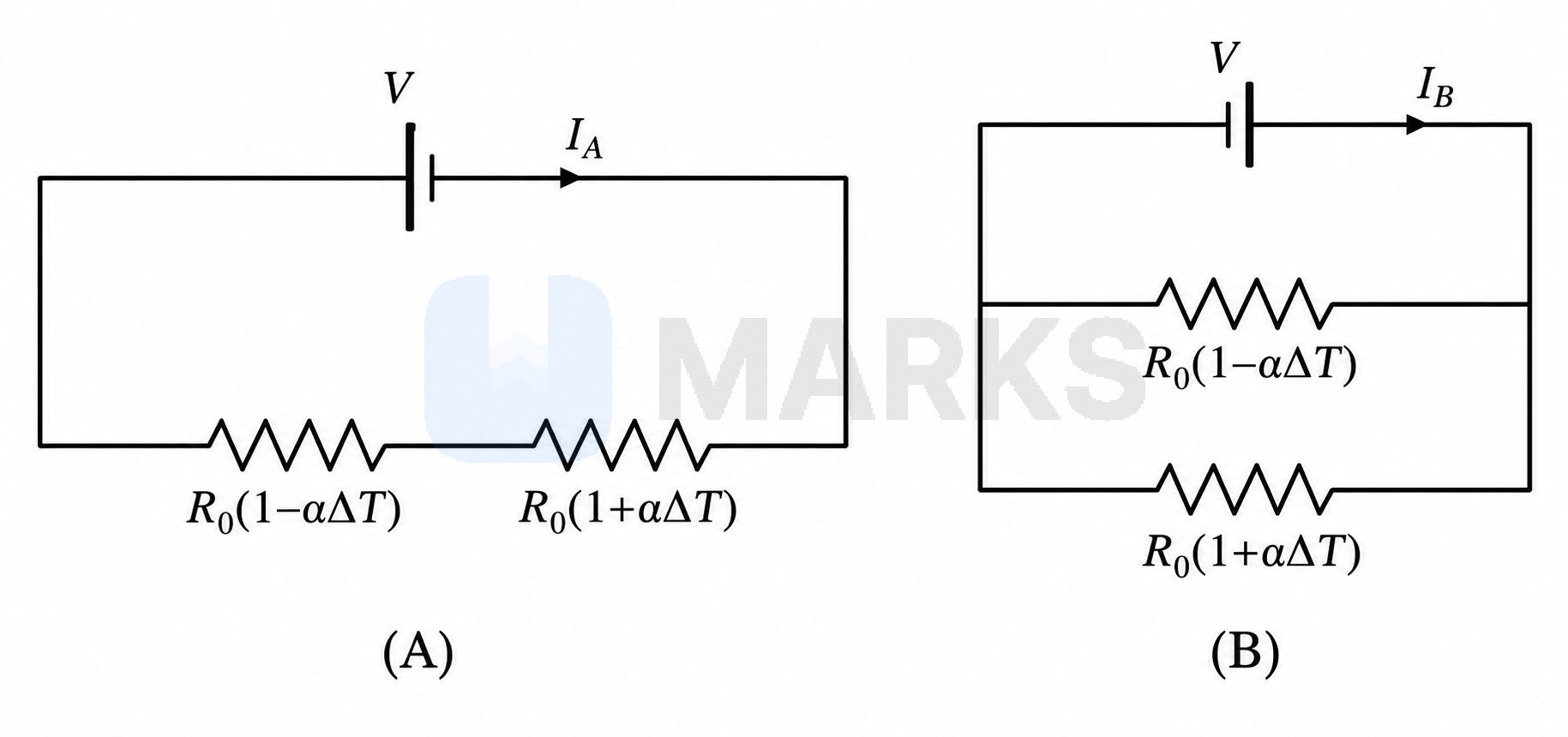
Consider two circuits, (A) and (B), each having two resistors. One of them has a positive temperature coefficient of resistance, $+\alpha$, while the other one has a negative temperature of coefficient, $-\alpha$, as shown in the figure. The current through these circuits are denoted by $I_A$ and $I_B$. At initial temperature, the resistance of the two resistors is $R_0$. As the temperature is increased, the correct option that describes the variation of current in these circuits is :
- Aboth $I_A$ and $I_B$ remain constant
- Correct answerB$I_A$ remains constant while $I_B$ increases
- C$I_A$ decreases while $I_B$ increases
- D$I_A$ increases while $I_B$ decreases
Solution
For circuit (A), the two resistors are connected in series.
The equivalent resistance is given by:
$R_A = R_0(1 - \alpha \Delta T) + R_0(1 + \alpha \Delta T) = 2R_0$
The current in circuit (A) is $I_A = \dfrac{V}{R_A} = \dfrac{V}{2R_0}$.
Since $R_A$ is independent of the temperature change $\Delta T$, the current $I_A$ remains constant.
For circuit (B), the two resistors are connected in parallel.
The equivalent resistance is given by:
$R_B = \dfrac{R_0(1 - \alpha \Delta T) \cdot R_0(1 + \alpha \Delta T)}{R_0(1 - \alpha \Delta T) + R_0(1 + \alpha \Delta T)}$
$R_B = \dfrac{R_0^2(1 - \alpha^2 \Delta T^2)}{2R_0} = \dfrac{R_0}{2}(1 - \alpha^2 \Delta T^2)$
As the temperature increases, $\Delta T$ increases, which means the term $(1 - \alpha^2 \Delta T^2)$ decreases.
Therefore, the equivalent resistance $R_B$ decreases.
The current in circuit (B) is $I_B = \dfrac{V}{R_B}$.
Since $R_B$ decreases with an increase in temperature, the current $I_B$ increases.
Thus, $I_A$ remains constant while $I_B$ increases.
Answer: $I_A$ remains constant while $I_B$ increases
The equivalent resistance is given by:
$R_A = R_0(1 - \alpha \Delta T) + R_0(1 + \alpha \Delta T) = 2R_0$
The current in circuit (A) is $I_A = \dfrac{V}{R_A} = \dfrac{V}{2R_0}$.
Since $R_A$ is independent of the temperature change $\Delta T$, the current $I_A$ remains constant.
For circuit (B), the two resistors are connected in parallel.
The equivalent resistance is given by:
$R_B = \dfrac{R_0(1 - \alpha \Delta T) \cdot R_0(1 + \alpha \Delta T)}{R_0(1 - \alpha \Delta T) + R_0(1 + \alpha \Delta T)}$
$R_B = \dfrac{R_0^2(1 - \alpha^2 \Delta T^2)}{2R_0} = \dfrac{R_0}{2}(1 - \alpha^2 \Delta T^2)$
As the temperature increases, $\Delta T$ increases, which means the term $(1 - \alpha^2 \Delta T^2)$ decreases.
Therefore, the equivalent resistance $R_B$ decreases.
The current in circuit (B) is $I_B = \dfrac{V}{R_B}$.
Since $R_B$ decreases with an increase in temperature, the current $I_B$ increases.
Thus, $I_A$ remains constant while $I_B$ increases.
Answer: $I_A$ remains constant while $I_B$ increases
Hence, the correct answer is option: 'B'.