Q164 / 270 · NDA 2016 (Phase 1) · Mathematics
Consider the function $\mathrm{f}(\mathrm{x})=\frac{27\left(\mathrm{x}^{2 / 3}-\mathrm{x}\right)}{4}$
How many solutions does the function $\mathrm{f}(\mathrm{x})=1$ have?
- AOne
- Correct answerBTwo
- CThree
- DFour
Solution
$\begin{aligned} f(x) & =\frac{27}{4}\left(x^{2 / 3}-x\right) \\ & =\frac{27}{4}\left(\left(x^2\right)^{1 / 3}-x\right)\end{aligned}$
For $f(x)=1$
$\begin{aligned}
& \frac{27}{4}\left(\left(x^2\right)^{1 / 3}-x\right)=1 \\
& \left(x^{1 / 3}\right)^2-x=\frac{4}{27}
\end{aligned}$
Put $x^{1 / 3}=y$
$x=y^3$
$\begin{aligned}
& y^2-y^3=\frac{4}{27} \\
& \Rightarrow y^3-y^2+\frac{4}{27}=0 \\
& \Rightarrow 27 y^3-27 y^2+4=0
\end{aligned}$
This is a cubic equation.
If we put $y=-\frac{1}{3}$ then $(3 y+1)=0$ is a factor of cubic equation.
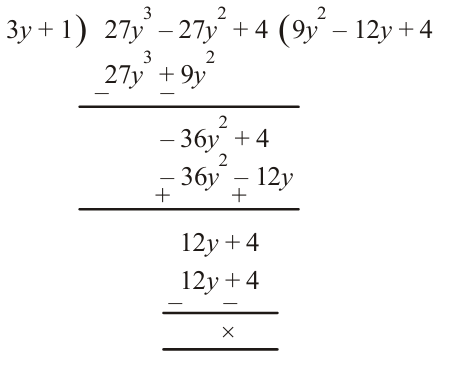
$\begin{aligned} & (3 y+1)\left(9 y^2-12 y+4\right)=0 \\ & (3 y+1)(3 y-2)^2=0 \end{aligned}$ Hence $y=-\frac{1}{3}, \frac{2}{3}$ Thus $f(x)=1$ has two solutions.
$\begin{aligned} & (3 y+1)\left(9 y^2-12 y+4\right)=0 \\ & (3 y+1)(3 y-2)^2=0 \end{aligned}$ Hence $y=-\frac{1}{3}, \frac{2}{3}$ Thus $f(x)=1$ has two solutions.
Hence, the correct answer is option: 'B'.