Q226 / 270 · NDA 2015 (Phase 2) · Mathematics
Consider the following statements :
1. The function $f(x)=x^2+2 \cos x$ is increasing in the interval $(0, \pi)$
2. The function $f(x)=\ln \left(\sqrt{1+x^2}-x\right)$ is decreasing in the interval $(-\infty, \infty)$
Which of the above statements is/are correct ?
- Correct answerA1 only
- B2 only
- CBoth 1 and 2
- DNeither 1 nor 2
Solution
$\begin{aligned} & f(x)=x^2+2 \cos x \\ & f^{\prime}(x)=2 x-2 \sin x \\ & =2[x-\sin x]\end{aligned}$
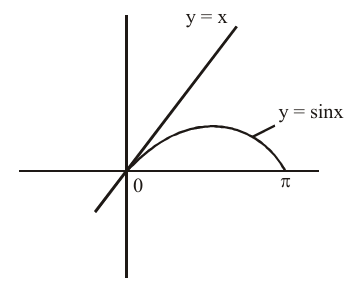
Between $(0, \pi) ;(x-\sin x)$ is always $+v e$, so $f^{\prime}(x)$ is always +ve. Hence it is increasing. $\begin{aligned} & f(x)=\ln \left(\sqrt{1+x^2}-x\right) \\ & f^{\prime}(x)=\frac{1}{\sqrt{1+x^2}-x} \times\left[\frac{2 x}{2 \sqrt{\left(1+x^2\right)}}-1\right] \\ & f^{\prime}(x)=\frac{1}{\sqrt{1+x^2}-x} \times\left(\frac{x}{\sqrt{1+x^2}}-1\right) \end{aligned}$ As $f^{\prime}(x)$ is -ve always, so this function is decreasing always.
Between $(0, \pi) ;(x-\sin x)$ is always $+v e$, so $f^{\prime}(x)$ is always +ve. Hence it is increasing. $\begin{aligned} & f(x)=\ln \left(\sqrt{1+x^2}-x\right) \\ & f^{\prime}(x)=\frac{1}{\sqrt{1+x^2}-x} \times\left[\frac{2 x}{2 \sqrt{\left(1+x^2\right)}}-1\right] \\ & f^{\prime}(x)=\frac{1}{\sqrt{1+x^2}-x} \times\left(\frac{x}{\sqrt{1+x^2}}-1\right) \end{aligned}$ As $f^{\prime}(x)$ is -ve always, so this function is decreasing always.
Hence, the correct answer is option: 'A'.