Q33 / 48 · JEE Advanced 2026 (Paper 1) · Physics
Consider a large disk of radius $R$ and two smaller disks, each of radius $r = R/50$, lying on its circumference, as shown in the figure. The smaller disks are initially in contact with each other, with an angular separation $\Delta\theta$ between their centers. They are made to roll without slipping in opposite directions, with constant angular velocities $\omega$ and $2\omega$ while the large disk is held stationary. The time $\tau$ at which the smaller disks are again in contact is:
[Use $\sin(\Delta\theta) = \Delta\theta$ and ignore gravity.]
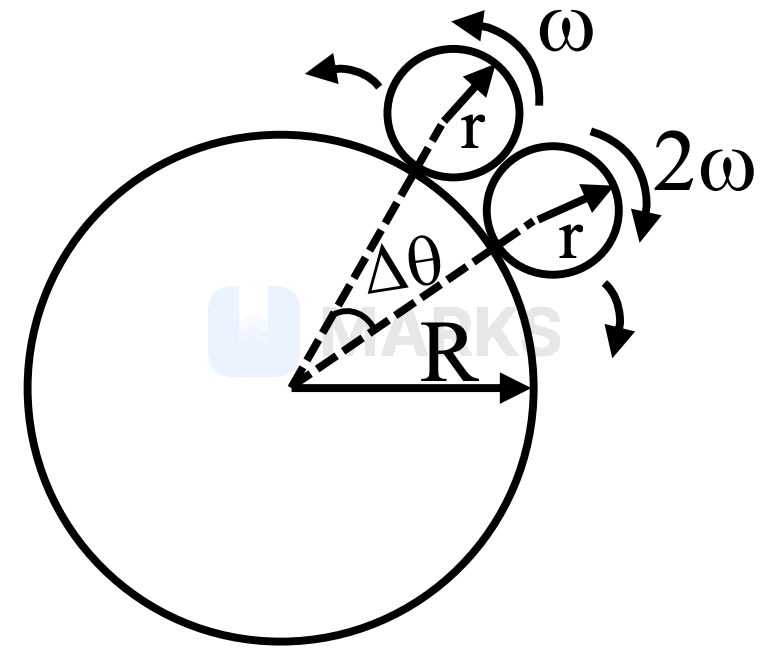
[Use $\sin(\Delta\theta) = \Delta\theta$ and ignore gravity.]
- A$\tau = 51 \times \left(2\pi - \dfrac{4}{51}\right) / \omega$
- B$\tau = 51 \times \left(2\pi - \dfrac{2}{51}\right) / 3\omega$
- Correct answerC$\tau = 51 \times \left(2\pi - \dfrac{4}{51}\right) / 3\omega$
- D$\tau = 51 \times \left(2\pi - \dfrac{2}{51}\right) / \omega$
Solution
Let the radius of the large disk be $R$ and the radius of the small disks be $r$. We are given $r = R/50$, which implies $R = 50r$.
The centers of the small disks move along a circular path of radius $R + r = 50r + r = 51r$.
When the two small disks are in contact, the distance between their centers is $2r$. The angular separation $\Delta\theta$ between their centers is given by the arc length (which is approximately the chord length for small angles):
$(R + r)\Delta\theta = 2r$
$(51r)\Delta\theta = 2r \implies \Delta\theta = \dfrac{2}{51} \text{ rad}$
The small disks roll without slipping on the stationary large disk. For a disk of radius $r$ rolling with angular velocity $\omega$, the velocity of its center is $v = \omega r$.
The angular velocity of the center of the first small disk about the center of the large disk is:
$\Omega_1 = \dfrac{v_1}{R+r} = \dfrac{\omega r}{51r} = \dfrac{\omega}{51}$
Similarly, for the second small disk rolling with angular velocity $2\omega$, the angular velocity of its center is:
$\Omega_2 = \dfrac{v_2}{R+r} = \dfrac{2\omega r}{51r} = \dfrac{2\omega}{51}$
Since they move in opposite directions, their relative angular velocity is:
$\Omega_{\text{rel}} = \Omega_1 + \Omega_2 = \dfrac{\omega}{51} + \dfrac{2\omega}{51} = \dfrac{3\omega}{51}$
The disks are initially in contact, meaning their centers are separated by an angle $\Delta\theta$. They will be in contact again when their centers are once again separated by $\Delta\theta$ after crossing each other on the opposite side of the large disk.
The total angular distance that the two centers must cover together is:
$\theta_{\text{total}} = 2\pi - 2\Delta\theta$
Substituting $\Delta\theta = \dfrac{2}{51}$:
$\theta_{\text{total}} = 2\pi - 2\left(\dfrac{2}{51}\right) = 2\pi - \dfrac{4}{51}$
The time $\tau$ taken for them to meet again is:
$\tau = \dfrac{\theta_{\text{total}}}{\Omega_{\text{rel}}} = \dfrac{2\pi - \dfrac{4}{51}}{\dfrac{3\omega}{51}}$
$\tau = \dfrac{51}{3\omega} \left(2\pi - \dfrac{4}{51}\right)$
Answer: $\tau = 51 \times \left(2\pi - \dfrac{4}{51}\right) / 3\omega$
Hence, the correct answer is option: 'C'.