Q25 / 59 · NEST (NISER) 2020 (Session 1) · Chemistry
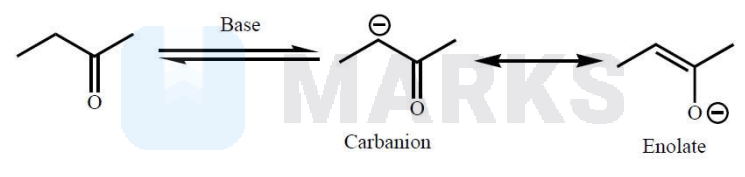
Carbanions derived from aldehydes/ketones are called enolates, as they represent anions (conjugate bases) of the enol forms. Enol ethers can be prepared and are synthetically important. These anions react with an alkyl halide at the carbon or oxygen atom.
Trimethylsilylchloride $\left(\mathrm{Me}_3 \mathrm{SiCl}\right)$ reacts almost exclusively with enolates. One such reaction is shown below, where ketone $\mathbf{I}$ is treated with LDA , followed by $\mathrm{Me}_3 \mathrm{SiCl}$ to obtain trimethylsilyl derivative of I. The possible intermediate carbanions (II and III) and the possible products (IV to VII) are shown. [LDA $=$ lithium diisopropylamide $\left(\mathrm{Li} \mathrm{N}\left(\mathrm{isoC}_3 \mathrm{H}_7\right)_2\right)$, is a strong base but a very poor nucleophile].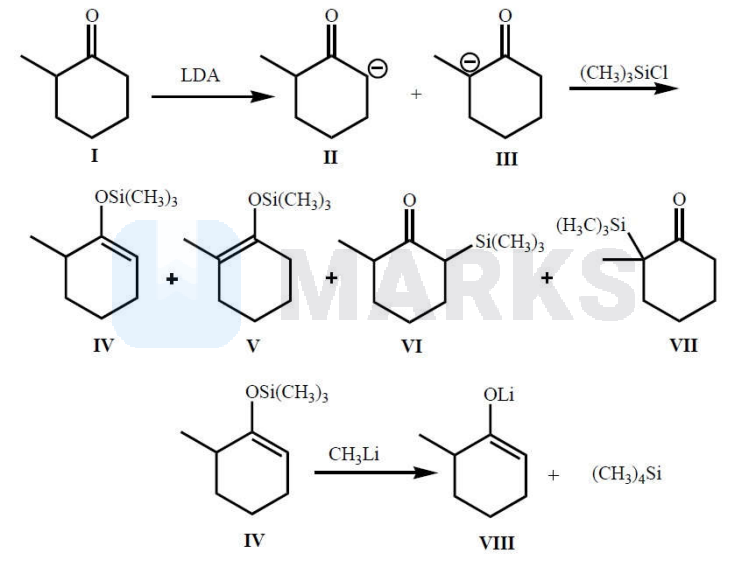
The correct statement(s) is(are):
Trimethylsilylchloride $\left(\mathrm{Me}_3 \mathrm{SiCl}\right)$ reacts almost exclusively with enolates. One such reaction is shown below, where ketone $\mathbf{I}$ is treated with LDA , followed by $\mathrm{Me}_3 \mathrm{SiCl}$ to obtain trimethylsilyl derivative of I. The possible intermediate carbanions (II and III) and the possible products (IV to VII) are shown. [LDA $=$ lithium diisopropylamide $\left(\mathrm{Li} \mathrm{N}\left(\mathrm{isoC}_3 \mathrm{H}_7\right)_2\right)$, is a strong base but a very poor nucleophile].
The correct statement(s) is(are):
- Correct answerAIII is more stable than II.
- Correct answerBThe activation energy for the formation of IV is lower than that of VI.
- Correct answerCIn the conversion of IV to VIII, $\mathrm{CH}_3 \mathrm{Li}$ function as a nucleophile.
- Correct answerDThe activation energy for the formation of II is lower than that of III.
Hence, the correct answer is options: 'A', 'B', 'C', 'D'.