Q15 / 60 · NEST (NISER) 2020 (Session 2) · Biology
Barbara McClintock observed non-Mendelian pigmentation patterns in maize (figure 1) mediated by transposons, as also observed in Petunia (figure 2 and 3). These somatic changes were inheritable as evident from the clonal patterns of pigmentation observed both in seeds and flowers.

As leaves grow, 'jumping genes' get activated and insert themselves into chlorophyll producing genes, thereby disrupting and inactivating them. This is typically seen as leaf pigment variegation ( $\mathbf{P}$ and Q ). Sometimes, the transposon jumps out from where it was inserted, restoring the chlorophyll gene function. Observing the leaf variegation patterns in P and Q , choose the correct statement(s).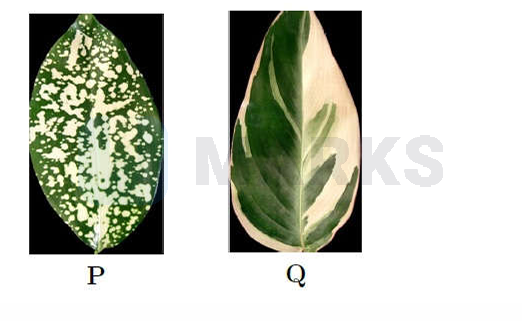
As leaves grow, 'jumping genes' get activated and insert themselves into chlorophyll producing genes, thereby disrupting and inactivating them. This is typically seen as leaf pigment variegation ( $\mathbf{P}$ and Q ). Sometimes, the transposon jumps out from where it was inserted, restoring the chlorophyll gene function. Observing the leaf variegation patterns in P and Q , choose the correct statement(s).
- AOnly Q shows clonal propagation of the variegated phenotype.
- Correct answerBOnly P largely indicates that the transposon can jump out of chlorophyll gene, restoring its function.
- CTissue culture propagated plants from green tissue of leaf Q will show no variegation.
- Correct answerDBoth $\mathbf{P}$ and Q show sporadic events of transposon-mediated variegation.
Hence, the correct answer is options: 'B', 'D'.