Q45 / 180 · COMEDK 2024 (Evening Shift) · Chemistry
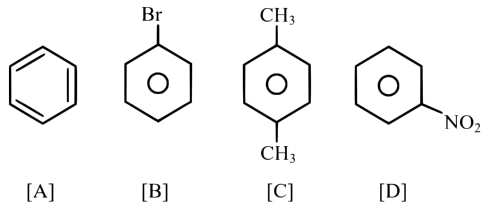
Arrange the following compounds in the increasing order of their reactivity when each of them is reacted with chloroethane / anhydrous AlCl$_3$.
- AD < A < B < C
- BC < B < A < D
- Correct answerCD < B < A < C
- DC < D < B < A
Solution
The reaction of chloroethane with anhydrous $AlCl_{3}$ is a Friedel-Crafts alkylation reaction. This reaction is an electrophilic aromatic substitution where the benzene ring acts as a nucleophile. The reactivity of the aromatic ring towards electrophilic substitution depends on the electron density of the ring. Electron-donating groups increase the electron density and thus increase the reactivity, while electron-withdrawing groups decrease the electron density and decrease the reactivity.
Let us analyze the substituents on the benzene rings:
Compound [A] is benzene, which has no substituents.
Compound [B] is bromobenzene. The $-Br$ group is deactivating due to its strong inductive effect ($-I$) which outweighs its resonance effect ($+M$) in terms of overall reactivity towards electrophilic substitution.
Compound [C] is p-xylene (1,4-dimethylbenzene). The two $-CH_{3}$ groups are electron-donating via inductive effect ($+I$) and hyperconjugation, significantly increasing the electron density of the ring.
Compound [D] is nitrobenzene. The $-NO_{2}$ group is a very strong electron-withdrawing group due to both $-I$ and $-M$ effects, making the ring highly deactivated.
Comparing the reactivity:
Nitrobenzene [D] is the least reactive due to the strong deactivating $-NO_{2}$ group.
Bromobenzene [B] is less reactive than benzene [A] because $-Br$ is deactivating.
Benzene [A] is less reactive than p-xylene [C] because p-xylene has two activating methyl groups.
Therefore, the increasing order of reactivity is D < B < A < C.
Answer: D < B < A < C
Hence, the correct answer is option: 'C'.