Q25 / 56 · NEST (NISER) 2014 · Chemistry
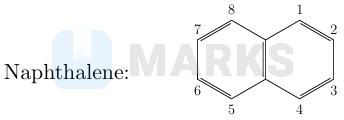
Aromatic compounds can be halogenated using molecular halogen in the presence of an acid. Benzene when treated with molecular bromine in the presence of ferric chloride gives bromobenzene. Naphthalene undergoes bromination with bromine in acetic acid. The kinetics of this reaction is interesting. The kinetic expression involves a term that is second order in bromine for the reaction in glacial acetic acid, and first order in bromine for the reaction in $50 \%$ aqueous acetic acid.
Aluminium chloride is much more active Lewis acid than ferric chloride and the halogenations can be carried out using $\mathrm{AlCl}_3$. The bond energies of $\mathrm{Al}-\mathrm{Cl}$ and $\mathrm{Al}-\mathrm{Br}$ are $502 \mathrm{~kJ} \mathrm{~mol}^{-1}$ and $430 \mathrm{~kJ} \mathrm{~mol}^{-1}$, respectively. The correct statement(s) is/are
Aluminium chloride is much more active Lewis acid than ferric chloride and the halogenations can be carried out using $\mathrm{AlCl}_3$. The bond energies of $\mathrm{Al}-\mathrm{Cl}$ and $\mathrm{Al}-\mathrm{Br}$ are $502 \mathrm{~kJ} \mathrm{~mol}^{-1}$ and $430 \mathrm{~kJ} \mathrm{~mol}^{-1}$, respectively. The correct statement(s) is/are
- AThe reaction of benzene with bromine in the presence of $\mathrm{AlCl}_3$ gives a substantial amount of chlorobenzene.
- Correct answerBThe reaction of naphthalene with bromine in the presence of glacial acetic acid involves reaction of two molecules of bromine with one molecule of naphthalene, and no involvement of acetic acid, in the rate determining step.
- Correct answerCThe reaction of naphthalene with bromine in $50 \%$ aqueous acetic acid involves bromine and acetic acid in the rate determining step.
- Correct answerDWhen 1-methylnaphthalene is reacted with bromine in the presence of a Lewis acid 4-bromo-1-methylnaphthalene is formed as the major product.
Hence, the correct answer is options: 'B', 'C', 'D'.