Q108 / 160 · AP EAMCET 2023 (16 May Shift 2) · Mathematics
$\mathrm{A}(1,15), \mathrm{B}(3,-12), \mathrm{C}(6,12)$ are three consecutive turning points of a continuous curve $y=f(x)$. If $f(x)=0$ only for $x=\alpha$ and $x=\beta$, then $|\beta-\alpha| < $
- A$27$
- B$2$
- Correct answerC$5$
- D$25$
Solution
Given that $\mathrm{A}(1,15), \mathrm{B}(3,-12), \mathrm{C}(6,12)$ are threeconsecutive turning points of continuous curve $y=f(x)$ and intersect $x$-axis at $x=\alpha$, and $x=\beta$.
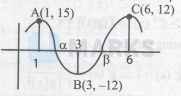
It is clear from graph is $\begin{aligned} & 1 < \alpha < 3 \text { and } 3 < \beta < 6 \Rightarrow-\alpha < -1 \text { and } \beta < 6 \\ & \Rightarrow|\beta-\alpha| < 6-1 \Rightarrow|\beta-\alpha| < 5 . \end{aligned}$
It is clear from graph is $\begin{aligned} & 1 < \alpha < 3 \text { and } 3 < \beta < 6 \Rightarrow-\alpha < -1 \text { and } \beta < 6 \\ & \Rightarrow|\beta-\alpha| < 6-1 \Rightarrow|\beta-\alpha| < 5 . \end{aligned}$
Hence, the correct answer is option: 'C'.