Q22 / 180 · COMEDK 2025 (10 May Shift 1) · Chemistry
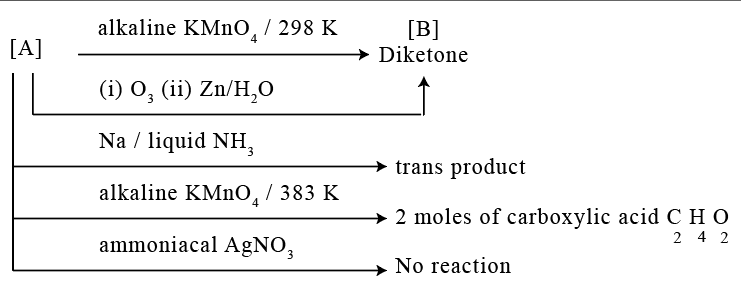
An unsaturated hydrocarbon $[\mathrm{A}]$ undergoes the following series of reactions. Identify $[\mathrm{A}]$.
- ABut-1-yne
- Correct answerBBut-2-yne
- CBut-2-ene
- DPropyne.
Solution
The hydrocarbon [A] reacts with ammoniacal $AgNO_3$ to give no reaction, which indicates that it is not a terminal alkyne. This eliminates but-1-yne and propyne.
The reaction of [A] with $Na/liquid NH_3$ gives a trans product, which is a characteristic reaction of internal alkynes to form trans-alkenes. This suggests [A] is an internal alkyne.
The reaction of [A] with alkaline $KMnO_4$ at 383 K yields 2 moles of a carboxylic acid with formula $C_2H_4O_2$, which is acetic acid ($CH_3COOH$). This implies that the oxidative cleavage of the triple bond in [A] produces two molecules of acetic acid. For an internal alkyne $R-C \equiv C-R$ to yield two molecules of $CH_3COOH$, the structure must be $CH_3-C \equiv C-CH_3$, which is but-2-yne.
Ozonolysis of but-2-yne ($CH_3-C \equiv C-CH_3$) followed by $Zn/H_2O$ yields a diketone, specifically butane-2,3-dione ($CH_3COCOCH_3$), which matches the description of [B].
Therefore, [A] is but-2-yne.
Answer: But-2-yne
Hence, the correct answer is option: 'B'.