Q132 / 150 · MHT CET 2026 (19 April Shift 2) · Physics
An uniformly charged thin spherical shell of radius 'R' has uniform surface charge density '$\sigma$'. It is made of two hemispherical identical shells held together by pressing them with force 'F' as shown. F is proportional to
[$\epsilon_0$ = permittivity of free space]
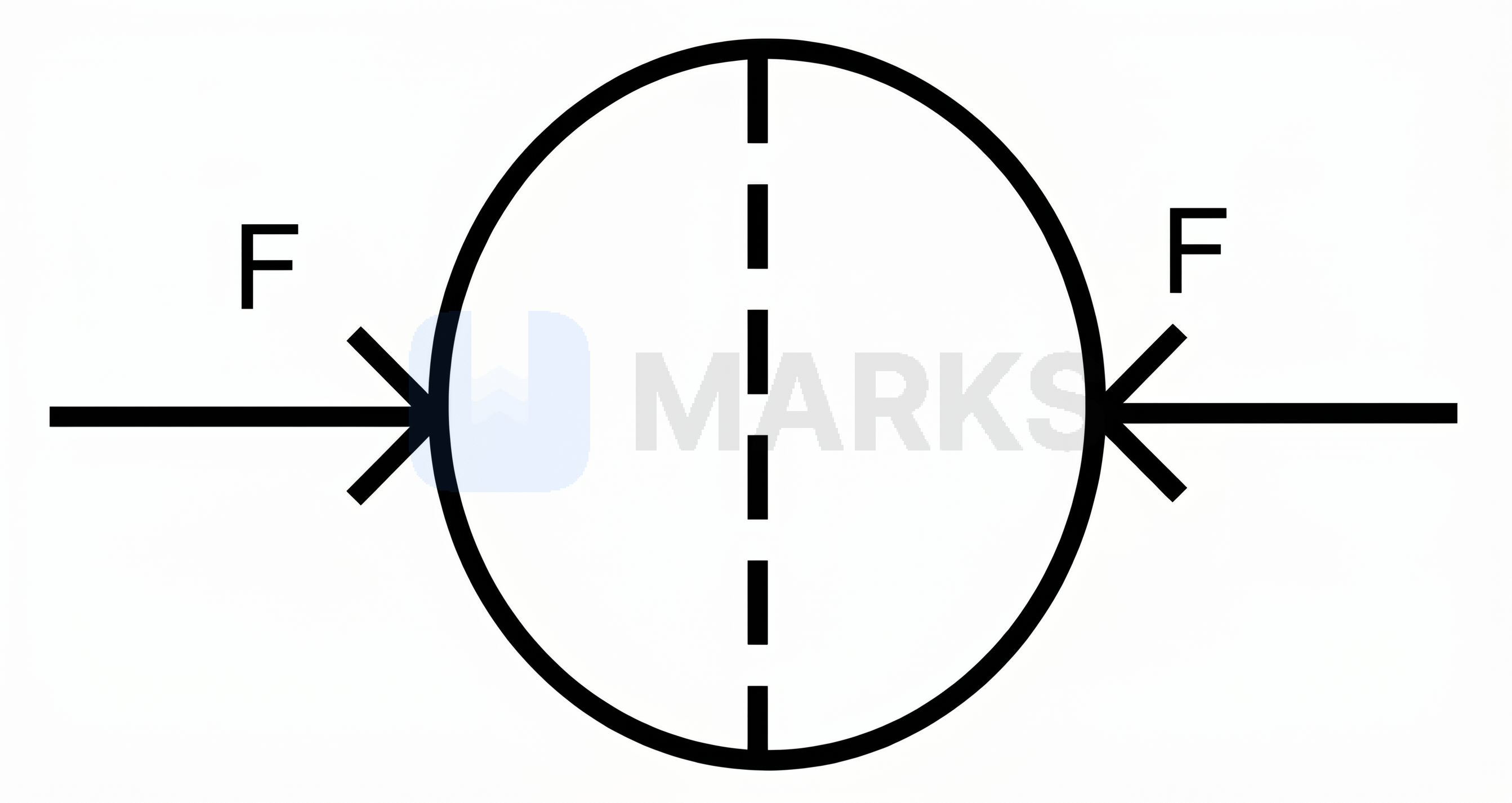
[$\epsilon_0$ = permittivity of free space]
- A$\dfrac{1}{\epsilon_0}\,\dfrac{\sigma^2}{R^2}$
- B$\dfrac{1}{\epsilon_0}\,\dfrac{\sigma^2}{R}$
- Correct answerC$\dfrac{1}{\epsilon_0}\,\sigma^2 R^2$
- D$\dfrac{1}{\epsilon_0}\,\sigma^2 R$
Solution
The electrostatic pressure $P$ on the surface of a uniformly charged thin spherical shell is given by:
$P = \dfrac{\sigma^2}{2\epsilon_0}$
Consider a small area element $dA$ on the surface of one of the hemispheres. The outward electrostatic force on this element is:
$dF = P dA = \dfrac{\sigma^2}{2\epsilon_0} dA$
By symmetry, the net force on the hemisphere will be directed along the axis perpendicular to its circular base. The component of the force along this axis is:
$dF_{\perp} = dF \cos\theta = P dA \cos\theta$
where $\theta$ is the angle between the radially outward normal and the axis of symmetry.
Integrating this over the entire surface of the hemisphere gives the total repulsive force:
$F_{rep} = \int P dA \cos\theta = P \int dA \cos\theta$
The term $\int dA \cos\theta$ represents the projected area of the hemisphere onto the plane of its base, which is simply the area of a circle of radius $R$:
$\int dA \cos\theta = \pi R^2$
Substituting this back, we get the net repulsive force:
$F_{rep} = \left(\dfrac{\sigma^2}{2\epsilon_0}\right) (\pi R^2) = \dfrac{\pi \sigma^2 R^2}{2\epsilon_0}$
To hold the two hemispheres together, the external applied force $F$ must balance this electrostatic repulsion:
$F = \dfrac{\pi \sigma^2 R^2}{2\epsilon_0}$
From this expression, it is clear that the force $F$ is proportional to $\dfrac{\sigma^2 R^2}{\epsilon_0}$.
Answer: $\dfrac{1}{\epsilon_0}\,\sigma^2 R^2$
Hence, the correct answer is option: 'C'.