Q56 / 75 · JEE Main 2026 (05 April Shift 2) · Physics
An object of uniform density rolls up the curved path with the initial velocity $v_0$ as shown in the figure. If the maximum height attained by an object is $\dfrac{7v_0^2}{10g}$ ($g$ = acceleration due to gravity), the object is a _______.
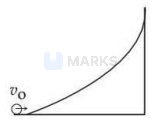
- Asolid cylinder
- Bring
- Cdisc
- Correct answerDsolid sphere
Solution
By the law of conservation of mechanical energy, the total initial kinetic energy of the rolling object is converted into potential energy at the maximum height.
Total initial kinetic energy for an object rolling without slipping is given by:
$K = K_{\text{translational}} + K_{\text{rotational}}$
$K = \dfrac{1}{2}mv_0^2 + \dfrac{1}{2}I\omega^2$
Substituting $\omega = \dfrac{v_0}{R}$ and $I = mk^2$ (where $k$ is the radius of gyration):
$K = \dfrac{1}{2}mv_0^2 + \dfrac{1}{2}(mk^2)\left(\dfrac{v_0}{R}\right)^2 = \dfrac{1}{2}mv_0^2\left(1 + \dfrac{k^2}{R^2}\right)$
The potential energy at the maximum height $h$ is:
$U = mgh$
Given $h = \dfrac{7v_0^2}{10g}$, we have:
$U = mg\left(\dfrac{7v_0^2}{10g}\right) = \dfrac{7}{10}mv_0^2$
Equating kinetic and potential energy ($K = U$):
$\dfrac{1}{2}mv_0^2\left(1 + \dfrac{k^2}{R^2}\right) = \dfrac{7}{10}mv_0^2$
$1 + \dfrac{k^2}{R^2} = \dfrac{14}{10} = \dfrac{7}{5}$
$\dfrac{k^2}{R^2} = \dfrac{7}{5} - 1 = \dfrac{2}{5}$
The moment of inertia is $I = \dfrac{2}{5}mR^2$, which corresponds to a solid sphere.
Answer: solid sphere
Hence, the correct answer is option: 'D'.