Q116 / 150 · MHT CET 2026 (18 April Shift 2) · Physics
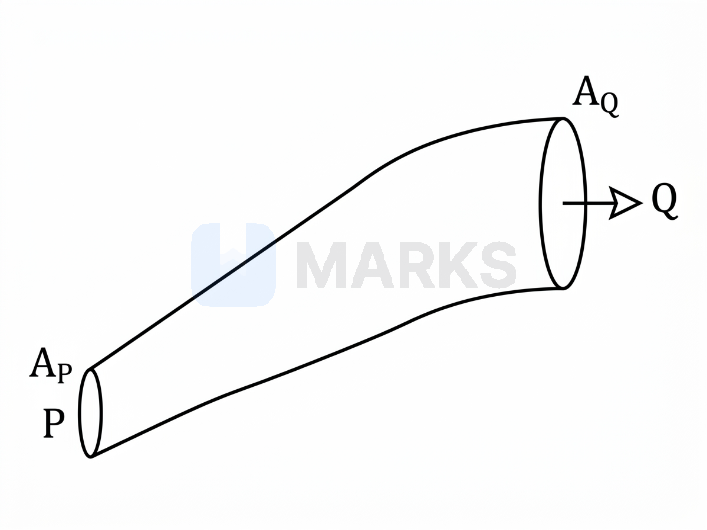
An incompressible fluid (ideal fluid) is flowing through non uniform cross-sectional tube PQ as shown in the figure from end P to end Q. If $K_P$ and $K_Q$ are the kinetic energy per unit volume of the fluid at end P and end Q respectively, then
- A$K_P = \dfrac{1}{2}K_Q$
- B$K_P = K_Q$
- C$K_P < K_Q$
- Correct answerD$K_P > K_Q$
Solution
From the given figure, the cross-sectional area of the tube at end P is less than the cross-sectional area at end Q, so $A_P < A_Q$.
According to the equation of continuity for an incompressible fluid, the product of cross-sectional area and velocity remains constant:
$A_P v_P = A_Q v_Q$
Since $A_P < A_Q$, the velocity of the fluid at P is greater than the velocity at Q, which gives $v_P > v_Q$.
The kinetic energy per unit volume of the fluid is given by $K = \dfrac{1}{2} \rho v^2$, where $\rho$ is the density of the fluid.
Since $v_P > v_Q$, it follows that $v_P^2 > v_Q^2$.
Therefore, $\dfrac{1}{2} \rho v_P^2 > \dfrac{1}{2} \rho v_Q^2$, which implies $K_P > K_Q$.
Answer: $K_P > K_Q$
Hence, the correct answer is option: 'D'.